A Taste of History at the Richmond Farmers’ Market
By Rachel Trachten | Photos by Zach Pine
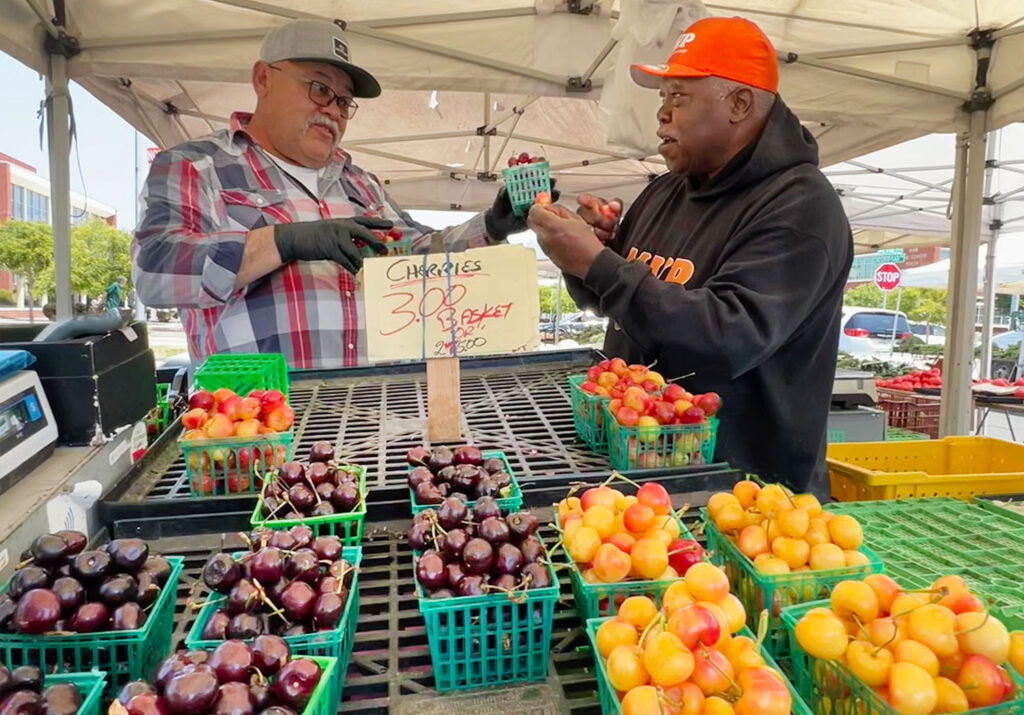
Uriel Castillo (left) of Busalacchi Farms and market founder Tom Cloman joke and reminisce as Cloman samples cherries.
Tom Cloman vividly recalls a time when farmers’ markets were few and far between. “There were only nine certified farmers’ markets in Northern California when we started,” says Cloman, who founded the Richmond market in 1984 and is still president of its market association.
Cloman is sampling cherries and reminiscing with Uriel Castillo of Stockton-based Busalacchi Farms, the market’s first farm vendor and still its anchor. Together, the founder and the farmer describe an era (before the region was filled with farmers’ markets) when customers lined up before opening time, with 3,000 people typically coming through the site each Friday. First established on the corner of Broadway and McDonald, the market soon moved to its current location at Civic Center Plaza. Castillo remembers blues music playing all day, and Cloman adds, “People would come and buy all of their vegetables for the week.”

Tom Cloman, who also serves as president of the Richmond Farmers’ Market Association, admires the veggies grown by an old friend, longtime Asian vegetable farmer Youa Maua.
Getting Launched
Cloman’s route to founding the market started with his own upbringing in rural Northern Louisiana, where his father farmed for himself and was also a sharecropper. “I grew up around agriculture—farming, doing stoop labor, picking cotton, pecans, peaches, pears, blackberries,” says Cloman. “I still have the scars to prove it.”
In 1979, Cloman was working for the Consumers’ Cooperative of Berkeley when he was tapped for a leadership role by then-governor Jerry Brown. The Brown administration was setting up a cooperative development program focused on bringing fresh fruits and vegetables into at-risk communities. Brown was trying to impact some of the state’s food deserts, starting with those in South Central Los Angeles.
The state also set up a cooperative in the San Francisco Tenderloin and one in West Oakland, but in Richmond, where Cloman lived, the numbers didn’t work. Based on feasibility studies, they needed a 5,000-square-foot storefront, something they couldn’t find in Richmond. Cloman met with a small group that had started a buying club and suggested a farmers’ market instead of a supermarket. The market began as a discussion group in late 1983 and got its charter in 1984.
Legislation regarding direct marketing also came into play. According to the Community Alliance with Family Farmers (CAFF), an easing of the rules regarding standardization of product size, labeling, packing, and containers led to the launch of California’s first certified farmers’ markets in 1977.

Huitla Mushroom Co farmer Kevin Perdomo (right) tells Gina Wright how portobello mushrooms change in shape, texture, and flavor as they grow. Co-owner Wei King is at left.
Mom Told Him to Vote Yes
It’s surprising to learn that the City Council approved the formation of the Richmond market by just one vote. Supermarkets, a powerful corporate constituency, were opposed, even though Richmond was so clearly a food desert. It was common practice, says Cloman, for women to carpool or share taxis to distant supermarkets each week in order to afford their weekly groceries. When the vote for the market charter came to the Council, it was then-Mayor Corcoran who was the tie-breaking vote in favor. Cloman explains: “His mother had told him he’d better vote yes because she grew up in Europe in that kind of environment where her family would go to the marketplace daily to purchase their fresh produce for that day.”
Forty-one years later, some loyal market customers still arrive at the Friday market in advance of its 7am opening. In April 2024, Richmond welcomed a sister market, operating on Sundays at the residential waterfront community of Marina Bay. This time, the City administration came to Cloman to request his support, which he was pleased to give.
The two markets have different personalities according to Aaron Coleman, who serves as market manager. “The Friday market is a stick and move market,” he says. “People don’t linger; they come mostly to buy. On Sunday it’s more of a hangout spot with people enjoying the market, spending more time.” At both spots, it’s easy to see that Coleman is perfect for the job as he walks around greeting people, troubleshooting, and answering questions. During an interview, he stopped our conversation twice: first to help honey vendor Catherine Edwards move her car and then to prevent two little girls from scootering near the street. Like Tom Cloman, Coleman has a history of living off the land—his grandfather and great-grandfather both had farms, and Coleman was also a professional bass angler.

Market staff (left to right: Theresa Dixon of Urban Tilth, Cary Grant of YouthWORKS, and market manager Aaron Coleman) take a break to enjoy the cherries.
Camaraderie at the Markets
“I like the people at the Richmond market,” says Catherine Edwards, who sells her Richmond Gold Honey on Fridays. “It’s down home in a lot of ways, with people from so many different walks of life.” At the market, Edwards has found people interested in having her put hives in their backyards and others ready to assist in hauling honey jars.
At the Sunday market, florist Julissa Perez of Richmond Blooms says that having her stall has led to orders for weddings, proms, and even a four-year-old’s birthday party where the kids built their own bouquets. She describes the market as a family where the vendors root for one another’s success. She even carries extra 40-pound weights in her car in case another vendor needs them to keep their stall from blowing over on a windy day. “It does get a bit uncomfortable when the weather is bad,” she says. “But then we’re out there, and Aaron’s ordering pizza for us and making sure we’re all okay.”

Florist Julissa Perez of Richmond Blooms gives John Walsh the bouquet he ordered for his wife’s birthday.
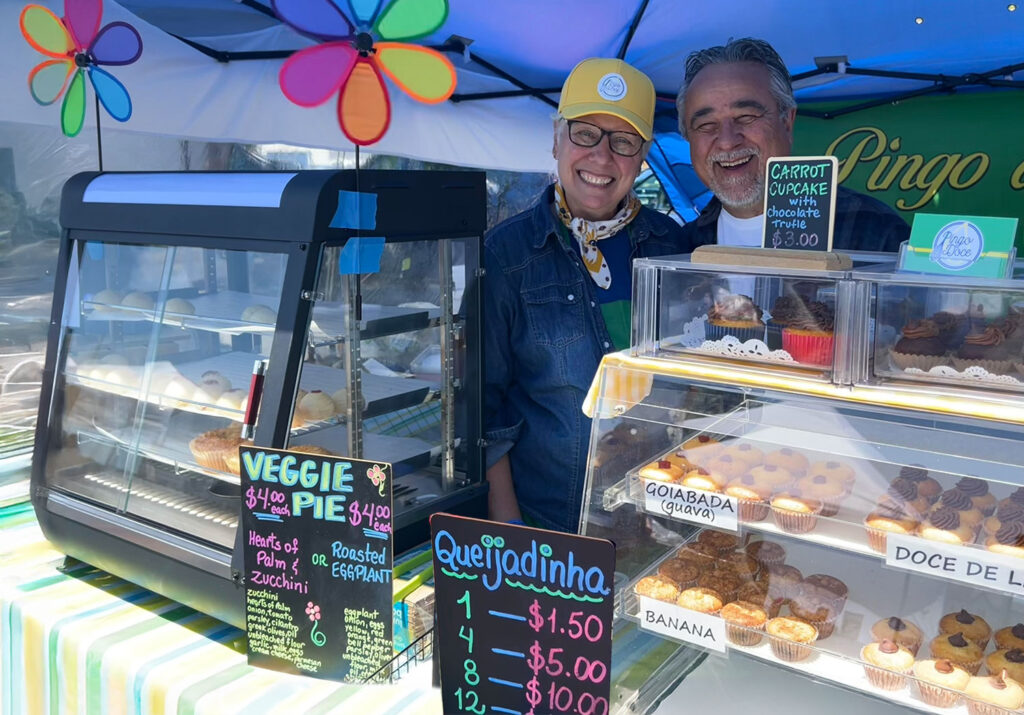
Marina Bay residents Paula and Sergio Pasquini started out as market customers excited to have fresh produce available so close to their home. But seeing the variety of goods being sold sparked the idea of selling Paula’s homemade Brazilian baked treats, like queijadinhas (tarts made with coconut) and the cheesy bread known as pão de queijo. After sampling her fare, Coleman gave her a thumbs up to become a vendor. A preschool teacher, Paula always offers some tiny treats, a favorite among the market’s youngest shoppers.

Young market shopper Dzineli Anku is a fan of the tiny treats at Pingo Doce, where Paula and Sergio Pasquini offer Brazilian baked goods.
Richmond nonprofit Urban Tilth plays an important role as a market partner, with staff member Theresa Dixon handling permits, inquiries, and other administrative needs. Dixon, who is on site on Sundays, helped bring in new offerings like a taco truck and a vegan food vendor. Nonprofit Fresh Approach is a regular at the Friday market, where they help shoppers use their EBT benefits to purchase market scrip and gain more from Market Match, which gives EBT recipients an extra $15 to spend on produce.
Tom Cloman likes to recall when a woman brought her six-foot-tall adult son to the market and a farmer remembered the son from when he was just a knee-high little kid. “Generationally, these folks have forged relationships,” says Cloman. “And the key for me is that our consumers—since we’ve been in existence for 41 years—know who grows their food, and conversely, our farmers know who they’re growing food for.” ♦
Brazilian Cheese Bread
(Pão de Queijo)
Paula and Sergio Pasquini are residents of Marina Bay and vendors at the Sunday farmers’ market, where they sell Paula’s Brazilian baked treats at Pingo Doce (“sweet drop” in Portuguese). Paula’s Italian grandparents immigrated to Brazil, where her grandmother and sisters baked for weddings and parties. “No doubt my family always inspired me to learn to cook and bake,” says Paula, “but I actually learned to make cheese bread here in the U.S. because it was something we missed so much. It’s a comfort food that you can eat anytime, and it brings us a little closer to our Brazilian roots.”
 Makes about 30 balls
- 2 cups (250 grams) tapioca flour
- 1 cup milk
- ½ cup water
- ¼ cup vegetable oil
- 2 eggs
- 1 cup (100 grams) Parmesan cheese
- 1 cup (100 grams) mozzarella cheese
- 1 teaspoon salt
Preheat the oven to 375°F.
Pour the tapioca flour into a bowl. In a small saucepan, combine milk, water, and oil and bring to a boil.
When the liquids are boiling, pour immediately into the tapioca flour and mix well (the dough will become very gummy looking).
Let the mixture cool down a little and add the eggs. (It works better if you use your hands from now on to work the dough.) Add the cheeses and salt and mix all together.
By greasing your hands a little, you can start to make small balls (about 30 or 40 grams).
Place the balls on a baking sheet with parchment paper or on a silicone tray and bake for 20 minutes or until they are puffed and golden.
Visits to the two Richmond farmers’ markets for this story gave writer Rachel Trachten and photographer Zach Pine a reminder about the fun of exploring markets in different parts of the East Bay. Each farmers’ market is an important part of our local food system. Each supports local growers and food artisans and also creates bonds that tie our community closer together. Read Rachel’s stories at clippings.me/users/rachel_trachten and learn about Zach’s environmental art projects at zpcreatewithnature.com and sandglobes.org.