A Fruitful Harvest
Urban Tilth grows food and opportunity in Richmond
Story and photos by Madelyn Markoe
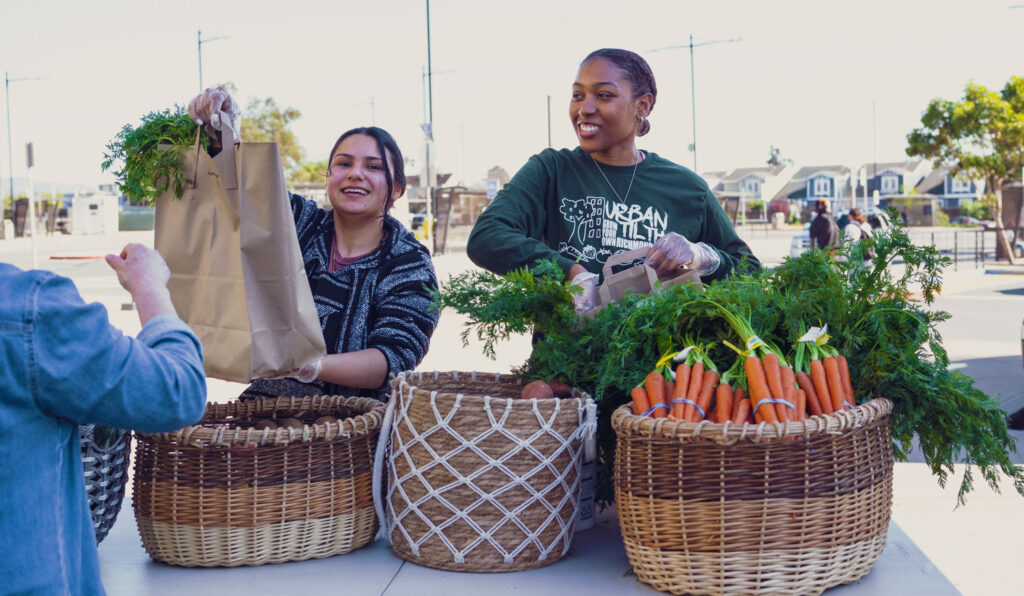
HEAL team members Bailey and Aracely distribute produce to community members at the opening of the Richmond Rising Community Hub.
After leaving the restaurant industry at the end of 2022, I began volunteering with 18 Reasons, a Bay Area nonprofit focused on empowering community through creativity and skills-building in the kitchen. One of the many free community programs they offer is the Cooking Matters series. These are six-week courses designed to teach people in food-insecure households how to buy, cook, and eat nutritious meals on a budget.
In May 2025, I was working as a Cooking Matters instructor and had signed up to teach a series at the Corrine Sain Senior & Family Community Center in Richmond. My group was composed of employees of the HEAL (Healthy Eating Active Living) programs at Urban Tilth, a Richmond-based nonprofit that has been a driving force in local food sovereignty since 2005. The organization contributes to a sustainable and healthy food system by providing fresh produce paired with educational programs that extend beyond the borders of their North Richmond Farm.
I’d taught the Cooking Matters series several times by this point, but this session was quite different due to the unique insights of the participants. At the end of each meeting, we would plan the following week’s menu based on ingredients the group knew were ready for harvest at the farm as well as dishes they were genuinely excited about learning how to cook.
One week’s menu included pesto, but since I had found no basil at the market, two of the HEAL team members headed over to the farm to harvest some from plants that were thriving under the early summer sun. Not only was it a treat to incorporate herbs just picked from less than a mile away, but we also got to experience the full circle of farm to table in real time. When we sat down to eat together, a sense of deep appreciation rippled throughout the room in recognition of the teamwork and the chance to enjoy the farm’s fresh offerings in a delicious dish.
Chinue Fields, director of the HEAL programs, described our 18 Reasons Cooking Matters series as a team-building and professional development opportunity for her HEAL team. “It allowed us to further our cooking skills and nutrition knowledge so we can pass that on to the community members we serve,” she said.

The Farm Collective members harvest chard, alliums, and spinach. Farm Manager Luis Jacobo (upper right) admires the rainbow chard he’s just harvested. Greenhouse Manager Maria Hernandez tends a flower bed next to the greenhouses.
Urban Tilth has a clear mission: “[to] inspire, hire, and train local residents to cultivate agriculture, feed our community, and restore relationships to land [in order] to build a more sustainable food system, within a just and healthier community.”
To cultivate agriculture, they grow food on their three-acre farm at 323 Brookside Drive and in a network of school and community gardens and orchards that they develop and tend. To feed the community, they offer that produce in more than 450 CSA boxes and at their Free Farm Stands, which are augmented by produce gleaned through their Orchard for ALL! program and by partnering with a diverse network of BIPOC-, women-, and LGBTQA+–led farms located as far as 200 miles away from Richmond.
Fields explained that aside from distribution of the food, her HEAL team seeks to bring community participants something more: “an understanding of the importance of their place within the local food system and how their food choices impact community health and the climate.” That involves teaching participants about the work they do at the farm, about the HEAL team’s monthly volunteer days, and about how to maintain a thriving home garden and put the good, fresh food to use in their kitchens.
I came to photograph the work going on at the farm on a sunny March morning when Free Farm Stand Manager Tania Jacobo was meeting with a group of volunteers. They had come to learn about winter cover crops. Before the knee pads came out and hands got dirty, Jacobo explained that cover crops are planted in winter to aid in managing soil erosion, fertility, and quality. The crop in front of the volunteers at that moment—a wild-looking blend of fava, crimson clover, hairy vetch, and rye grass—was knee high and dancing in the light wind as they prepared to chop it down and return the nutrients to the soil.
Jacobo had picked up some large garden shears when volunteer Nathan Hinchey remarked, “So, we’re giving them a buzz cut!” He said he had been looking to volunteer and learn about gardening. “I had driven by Urban Tilth before, and it seemed like a cool idea,” he said. “I wanted to be committed to the physical land.”

Top: Volunteer Trina Thierry at work in the cover crop. Bottom: Farm Coordinator Keshawn “King” Stanley loves operating the farm’s BCS mower.
Down the row, volunteer Trina Thierry and her daughter were making a dent in the high grass. Thierry recalled that Urban Tilth caught her eye around MLK Day in 2018 when Urban Tilth was building a clay fire pit for a local school. She wanted to learn how to garden and began participating in workshops and then volunteered.
“Learning from them has been really helpful, and it’s hands-on,” she said. “That’s how you learn.”
Turning her attention back to the cover crop, she continued to shear with a calm sense of care and appreciation. “I enjoy being here. It’s more of a me feeling,” she said. It was clear that for these volunteers, connecting with land nourishes more than just the soil.
As the volunteers were completing the cover crop’s buzz cut, I wandered over to photograph the farm team at work harvesting some food crops.
“That spinach right behind you grew over the weekend,” said Farm Coordinator Keshawn “King” Stanley. “They were very low on Friday and in two days they got like that,” he added on this day near the end of California’s record-breaking mid-March heat wave.
King said he came to Urban Tilth three years ago after dropping out of high school. He was working at a water store in downtown Richmond when Chito Floriano, Urban Tilth’s director of farm programs, came recruiting.
“I didn’t know he was the director, but it’s just like I tell everybody, ‘Treat everybody kindly because you never know who that person might be in the future.’”
Floriano invited King to apply for Urban Tilth’s Rudy Lozito Fellowship.
“It was beautiful, because I didn’t know anything about that,” King said. “It was probably the best program ever. They paid you to learn how to farm.”
On completing the fellowship, King was hired into a permanent role. “It was always my dream to learn how to farm. It felt like it was in my blood, like this is what I’m supposed to be doing. There’s unlimited food here. I can eat from the trees: apples, pears, and things of that nature,” he said.
When I asked King about crop germination, he quickly pointed toward the greenhouses. “That’s Miss Maria,” he said.
“Miss Maria” is Farm Collective Member and Greenhouse Manager Maria Hernandez, a 20-year resident of North Richmond, who learned most of her skills on her family’s farm in Oaxaca, Mexico. “It’s a big rancho with 2,000 fruit trees,” she said with a huge smile. “I’m planting flowers today, but I’m usually inside.”
In the nearby greenhouse, she picked up a stick from the mulch-lined floor to use as a tiny trowel for digging a zucchini seedling out of a tray. She patted it into a larger pot, where it will flourish until it’s strong enough to go into the ground. In another greenhouse, she showed me cuttings of rosemary, fig, blackberry, and passion fruit that were sending new roots into the soil. Most of the seedlings and cuttings are grown to be offered to the community at Urban Tilth’s Free Nursery Stands, which are located at the North Richmond Farm, at Unity Park, and at the Greenway Community Gardens.
In further conversations with HEAL director Fields, I learned that since its inception in 2005, Urban Tilth has earned income through their educational programs, sales of products and services, and fundraising events. But they are also reliant on grants, corporate sponsorships, and individual donations from community supporters and philanthropies.
“The fundraising landscape has changed,” Fields adds, and individual donations have slowed as well.

In March, the Free Nursery Stand on the North Richmond Farm was well stocked with vegetable and herb starts for community members to take home and plant.
An example of the downturn sits visibly on the North Richmond Farm in the form of the unfinished Community Resilience Center, which was funded in 2023 by an EPA grant of $19 million. Intended as a refuge for Richmond residents during climate emergencies, the Center would also provide a space for food distribution, economic endeavors, and community gatherings. Urban Tilth had obtained permits and begun construction when the grant was revoked without warning in March 2025, leaving the project in limbo and causing ripples of uncertainty throughout the organization.
Fields says that HEAL’s Food as Medicine program has been able to expand programming with help from a California Strategic Growth Council Transformative Climate Communities grant, which also supported the March opening of an office and community hub for Richmond Rising, a coalition of Urban Tilth and six other local organizations working together to implement community-envisioned projects.
I came away from my visits at Urban Tilth feeling I had witnessed a dynamic manifestation of community values in joy, recovery, and gathering. It’s a model for how people working together can cultivate a future where residents return to the land with a more sustainable outlook and a deepened relationship to themselves and others. ♦
18reasons.org | urbantilth.org | richmondrisingca.org
Madelyn Markoe is a Bay Area photographer and songwriter whose work explores people, place, and connection through narrative-driven imagery. A former restaurateur with a background in music, her photographs have appeared in Condé Nast Traveler Spain and Bon Appétit. When she’s not behind the camera or with pen and paper, she can be found playing in the wind and surf or at the piano with her cat. madsophotography.com