A David Lebovitz Recipe Replay List
Two updated David Lebovitz cookbooks reviewed by Kristina Sepetys

David Lebovitz in Paris. Photo by Ed Anderson
We were at a local ice cream shop the other night, enjoying crisp waffle cones filled with burnt caramel ice cream. The deep mahogany-colored caramel had a slightly acrid bittersweet edge against the cold creaminess, which prompted my daughter to look at hers and say, “We need to make David Lebovitz’s burnt caramel ice cream recipe. It’s the best ever. Hands down.”
She’s right. Early in his cooking career, Lebovitz spent 13 years as a pastry chef at Chez Panisse in Berkeley before moving to Paris. His cookbooks—and he’s written many—are filled with recipes easily managed in a home kitchen that honor the ingredients, letting butter, chocolate, and fruit speak for themselves through simplicity and balance rather than elaboration. Lebovitz notes that Alice Waters, when writing an introduction to one of his cookbooks, said, “It takes someone like David to know how to end a meal without obliterating what came before.”
I’ve been making Lebovitz’s recipes for years and can confirm that most share that particular enhancing restraint: a pinch of fleur de sel that makes dark chocolate taste almost savory, sour cream that deepens vanilla until it tastes like the whole plant, sauerkraut (yes, sauerkraut) that adds subtle sharpness and moisture to chocolate cake (shouldn’t work, but does). His aren’t recipes built on excess. They’re built on subtlety, where an ingredient doesn’t announce itself but makes you taste the dessert differently. Another favorite in our household is a simple Lebovitz pound cake, gently flavored with bay leaf and a sweet orange glaze. The restraint is such that people say, “Mmm, this is really good. What’s in it?”
Two beloved Lebovitz cookbooks have just been updated, revised, and reissued: Ready for Dessert: My Best Recipes and The Great Book of Chocolate: The Chocolate Lover’s Guide with More than 50 Recipes.
Ready for Dessert, the more versatile of the two, is a collection of elegant, reliable confections, from cakes to ice creams to tarts, that makes sophisticated baking feel manageable in a home kitchen. The Great Book of Chocolate is more of an obsession-piece—part primer, part recipe collection, and part love letter to cacao—ideal for cooks who want to understand chocolate as deeply as they enjoy eating it.
To get a sense of the Lebovitz style, look for desserts like these:
- A bittersweet chocolate mousse with pear and fig chutney (the fruit-bright tartness cutting through dark cocoa)
- An orange-cardamom flan (the spice so subtle you smell it before you taste it)
- A black currant tea crème brûlée (with its bitter-tart fruit against crackle of caramelized sugar), anise-orange ice cream profiteroles with chocolate sauce
Every recipe is long on flavor and depth, never just sugary sweetness. They’re also long on chocolate, Lebovitz’s particular passion, born from his introduction to Guittard at Chez Panisse, deepened through chocolate school in Belgium, and reflected in his exhaustive (and useful) list of Paris chocolatiers in The Great Book of Chocolate. The book opens with chocolate fundamentals (how to temper, how to choose quality chocolate, how to taste it the way you’d taste wine) before moving into recipes that range from the straightforward to the unexpected. There’s a molten chocolate cake that collapses into warmth on the plate; a dark, silky chocolate mousse; a chocolate soufflé; every recipe a delicious ode to chocolate.
Lebovitz also understands chocolate’s savory side. For that there’s a mole recipe with its layered spices, chili con chocolate with its heat and depth, a complex-tasting chocolate sauce for duck. Each recipe trusts that good chocolate needs only the right partner—whether that’s a whisper of sea salt, the earthiness of cinnamon, or the shock of chili heat—to become one of those combinations my family asks to be replayed.
These are recipes that belong in hard copy on a shelf, not somewhere in your browser history. They’re the recipes that actually work, the ones you’ll make again and again until you know them by heart.
The Great Book of Chocolate: The Chocolate Lover’s Guide with More than 50 Recipes
By David Lebovitz, (Ten Speed Press, 2026)
Ready for Dessert: My Best Recipes
by David Lebovitz (Ten Speed Press, 2026)
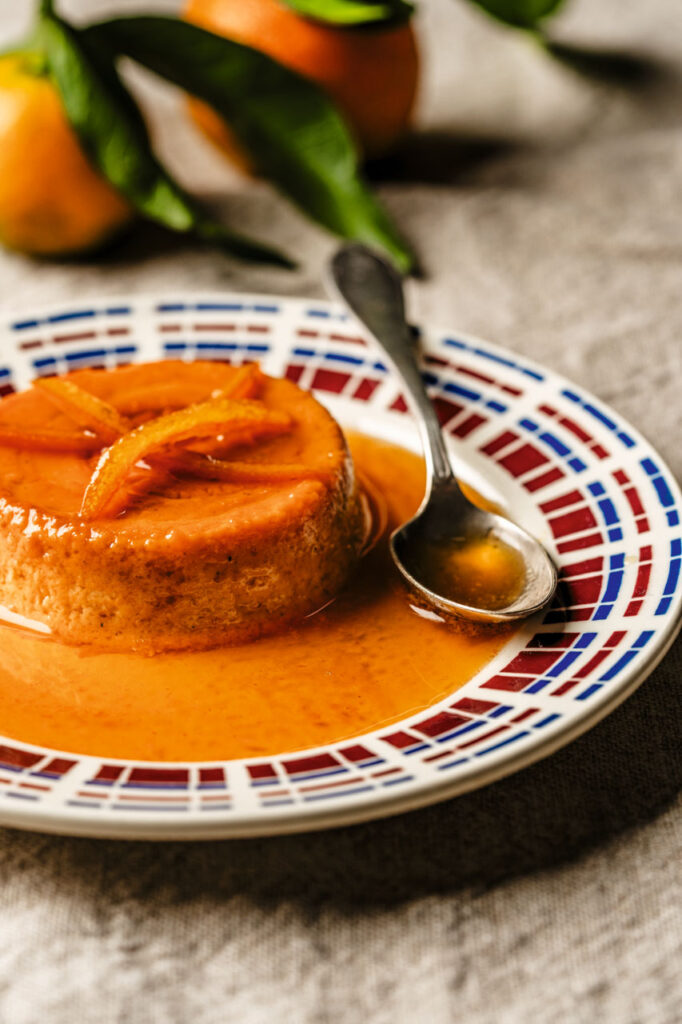
orange-cardamom flan
From Ready for Dessert by David Lebovitz
Photography by Ed Anderson used with permission
Many countries have their own version of caramelized custard turned out of its mold for serving—from flans on a slab of ice, sold from street carts in Mexico, to French cafés with red checkered tablecloths serving crème renversée for dessert. No border seems to be a barrier to the migration of this universally popular dessert.
Cardamom used to be considered an exotic spice but has become a lot more popular in recent years thanks to its use in knotted Swedish buns, which has made good-quality cardamom more accessible. (Two excellent sources are Burlap & Barrel and Diaspora Co.)
The flavor of pre-ground cardamom dissipates quickly, and you’ll miss the wonderful aroma of just-crushed seeds, so I recommend using seeds that you extract yourself from cardamom pods.
Makes 8 servings
Serving: Serve the flans cold.
Storage: The baked custards will keep in the refrigerator for up to 3 days.
Custard
- 1 teaspoon cardamom seeds
- 3 cups (750ml) whole milk
- Grated zest of 2 oranges, preferably organic or unsprayed
- ¾ cup (150g) sugar
- 3 large eggs, at room temperature
- 3 large egg yolks
- caramel
- ¼ cup (60ml) plus ¼ cup (60ml) water
- ¾ cup (150g) sugar
- Pinch of cream of tartar, or a few drops of freshly squeezed lemon juice
To make the custard, lightly crush the cardamom seeds in a mortar and pestle or seal them in a sturdy plastic bag and crush them with a rolling pin.
In a medium saucepan, heat the milk, crushed cardamom seeds, orange zest, and ¾ cup (150g) sugar, stirring to dissolve the sugar. Once warm, remove from the heat, cover, and let steep for 1 hour.
Set eight 4- to 6-ounce (125ml to 180ml) ramekins or custard cups in a roasting pan or deep baking dish.
To make the caramel, pour ¼ cup (60ml) water into a medium heavy skillet. Evenly distribute the ¾ cup (150g) sugar over the water and add the cream of tartar or lemon juice. Cook over medium heat until the sugar dissolves. Continue to cook without stirring but swirl the pan if the sugar is clumping or begins to brown unevenly.
When the caramel turns dark amber in color and begins to foam a bit, remove from the heat and immediately add the remaining ¼ cup (60ml) water. The caramel will bubble up vigorously, then the bubbling will subside. Stir with a heatproof spatula until any hardened bits of caramel completely dissolve. Divide the hot caramel evenly among the ramekins, then carefully swirl each ramekin so that the caramel coats the sides halfway up. Let cool completely.
Preheat the oven to 325°F (160°C).
To finish the custard, reheat the milk mixture until it’s quite warm. In a medium bowl, whisk together the eggs and egg yolks, then gradually whisk the warm milk into the eggs, whisking constantly as you pour to prevent the eggs from cooking (don’t whisk too vigorously, which will create air bubbles). Pour the mixture through a fine-mesh strainer into a large measuring cup or pitcher.
Divide the custard mixture evenly among the caramel-lined ramekins. Fill the roasting pan or baking dish with warm water to reach halfway up the sides of the ramekins. Cover the pan tightly with aluminum foil and bake until the perimeters of the custards are just set and the centers are still slightly jiggly, 25 to 35 minutes.
Transfer the custards from the water bath to a wire cooling rack and let cool completely. Cover with plastic wrap and refrigerate until chilled.
To unmold, run a sharp knife around the inside of each ramekin to loosen the custard, invert a serving plate or bowl over the ramekin, and turn them over together. Shake a few times to release the custard, then lift off the ramekin. (If the custard is stubborn, using a finger, gently pull it away from the side of the ramekin and invert again; it should slide out easily.) Pour any caramel remaining in the ramekin over the flan.
Accompaniments: Surround the custards with poached dried fruit of your choosing. To make the poaching syrup: In a saucepan, heat 1 part honey or sugar to 4 parts water along with 1 cinnamon stick or 1 vanilla bean, split lengthwise. Once the syrup is warm, drop in pitted prunes; raisins; dried apricots, figs, cranberries, or cherries; or any combination of dried fruits. Simmer gently until the fruits are plump and soft.
You can also top the flans with a few strips of candied orange peel.
Recipe reprinted with permission from Ready for Dessert by David Lebovitz, copyright © 2025. Published by Ten Speed Press, a division of Penguin Random House, LLC.
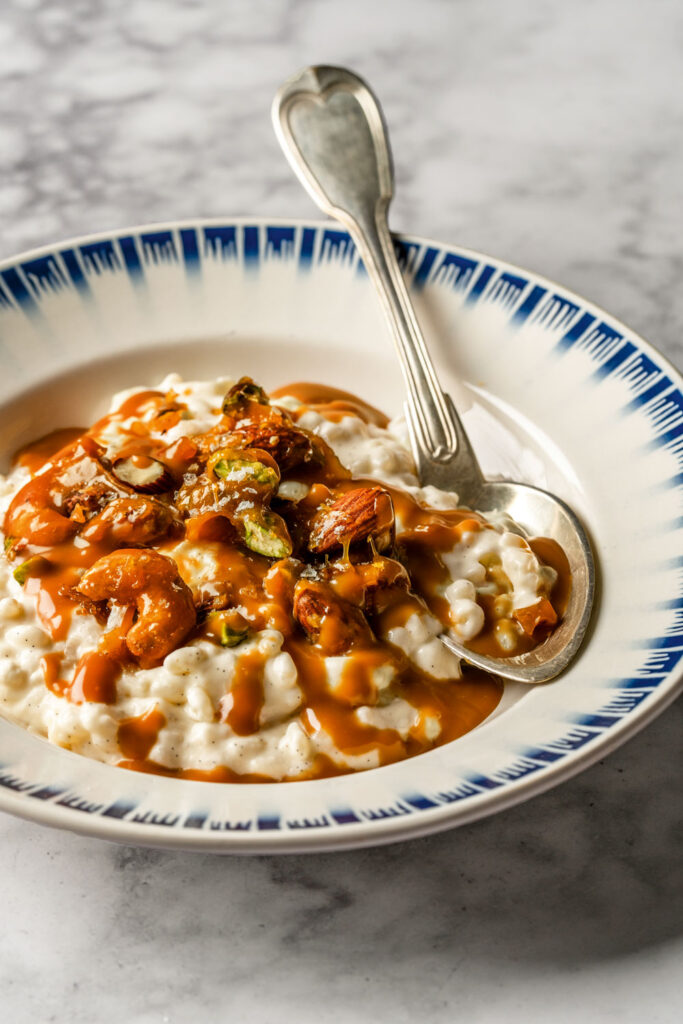
riz au lait with salted butter caramel and nougatine
From Ready for Dessert by David Lebovitz
Photography by Ed Anderson used with permission
My partner, Romain, was born and raised in France, and for the longest time he refused to eat riz au lait (rice pudding) because he had to eat it in elementary school. His strong aversion to it tells me that it wasn’t very good. (Another French friend told me he was regularly served stewed beef tongue in school, which Romain doesn’t have to worry about me serving at home.)
My version is inspired by the riz au lait served at L’Ami Jean in Paris. Theirs gets a spoonful of caramel mousse, but I prefer the easier route and drizzle it generously with warm salted butter caramel sauce and top it off with a nutty nougatine, using a mix of toasted nuts and a hint of salt. I knew this was a hit when I made it for Romain and he not only kept digging his spoon in but asked for seconds. Needless to say, it’s staying on the menu here.
Serving: Spoon the rice pudding into serving bowls and drizzle caramel generously over each bowl of the pudding and garnish with chopped nougatine.
Storage: The rice pudding can be stored in the refrigerator for up to 3 days and served cold or at room temperature.
The nougatine can be made up to 5 days ahead and stored in an airtight container at room temperature.
riz au lait
- 1 quart (1L) whole milk
- 1 cup (200g) round (short-grain) rice (see Note)
- 1/8 teaspoon salt
- 1 vanilla bean, split lengthwise, or 1 teaspoon vanilla bean paste
- ¾ cup (150g) sugar
- ½ teaspoon pure vanilla extract
- ½ cup (125ml) heavy cream
nougatine
- 1 cup (200g) sugar
- 2 tablespoons (1 ounce) unsalted or salted butter, cubed, at room temperature
- 1 cup (120g) toasted nuts; a mix of almonds, hazelnuts (loose skins removed), pecans, peanuts, cashews, sliced almonds, and pistachios (which usually come toasted, so no need to toast them)
- Kosher or flaky sea salt, such as fleur de sel or Maldon
- Salted butter caramel sauce
To make the riz au lait, pour the milk into a medium heavy saucepan and stir in the rice and 1/8 teaspoon salt. Scrape the vanilla beans from the pod, if using, and add them and the pod to the milk, or add the vanilla bean paste.
Bring the mixture to a boil, stirring occasionally, then decrease the heat so that the milk is at a steady but persistent simmer.
Continue to cook, stirring frequently, making sure to scrape the bottom of the saucepan to prevent scorching.
After 20 minutes, add the 3/4 cup (150g) sugar and continue to cook, stirring often, until most of the milk has been absorbed by the rice and the rice is tender, about 15 minutes. (It may take less or more time, depending on the rice.) When ready, the mixture should be the consistency of cooked oatmeal. Scrape the rice into a medium bowl and stir in the vanilla extract. Remove the vanilla bean pod (it can be rinsed, dried, and used for another purpose; see page 24) and whisk the mixture vigorously for 3 seconds to break the rice up a bit, which makes it creamier. Let the rice cool to room temperature, stirring occasionally to help it cool down faster.
In a stand mixer fitted with the whip attachment (or by hand), whip the cream on high speed until it holds soft peaks, then fold it into the cooled rice.
To make the nougatine, lightly oil a baking sheet or line it with a silicone baking mat.
Spread the 1 cup (200g) sugar in an even layer in a medium heavy skillet and cook over medium heat without stirring until the sugar begins to melt on the bottom of the pan or around the edges. Using a heatproof spatula, slowly drag the liquified sugar to the center and stir gently until all the sugar is melted. Continue to cook until the caramel becomes a medium amber color. Remove from the heat and quickly stir in the butter until it’s almost all melted, then stir in the nuts and a sprinkle of kosher salt, using the spatula to scrape the caramel from the bottom of the pan to coat the nuts quickly before the caramel hardens. (If it does harden, you can gently rewarm the pan over medium heat until the nut mixture loosens up.)
Scrape the caramelized nuts in the caramel onto the prepared baking sheet and spread the mixture quickly, and as evenly as possible, without overworking it. Let cool completely.
When cool, coarsely chop the nougatine into bite-size chunks, but not too fine; I like it when some of the nuts are still whole.
Warm the salted butter caramel sauce in a saucepan over low heat, stirring until smooth and pourable.
Note: It’s traditional to make riz au lait with riz rond (round rice), also known as short-grain rice. Don’t confuse it with sweet glutinous or sticky rice. And while arborio rice will work, it can be very starchy (and more expensive), so I don’t prefer it.
Recipes reprinted with permission from Ready for Dessert by David Lebovitz, copyright © 2025. Published by Ten Speed Press, a division of Penguin Random House, LLC.
Click here to purchase Ready for Dessert from Penguin Random House.
For The Great Book of Chocolate, purchase here.