The Path of the Strawberry
An Artist’s Homage
Oil Paintings by Rose Wright | Story by Cheryl Angelina Koehler
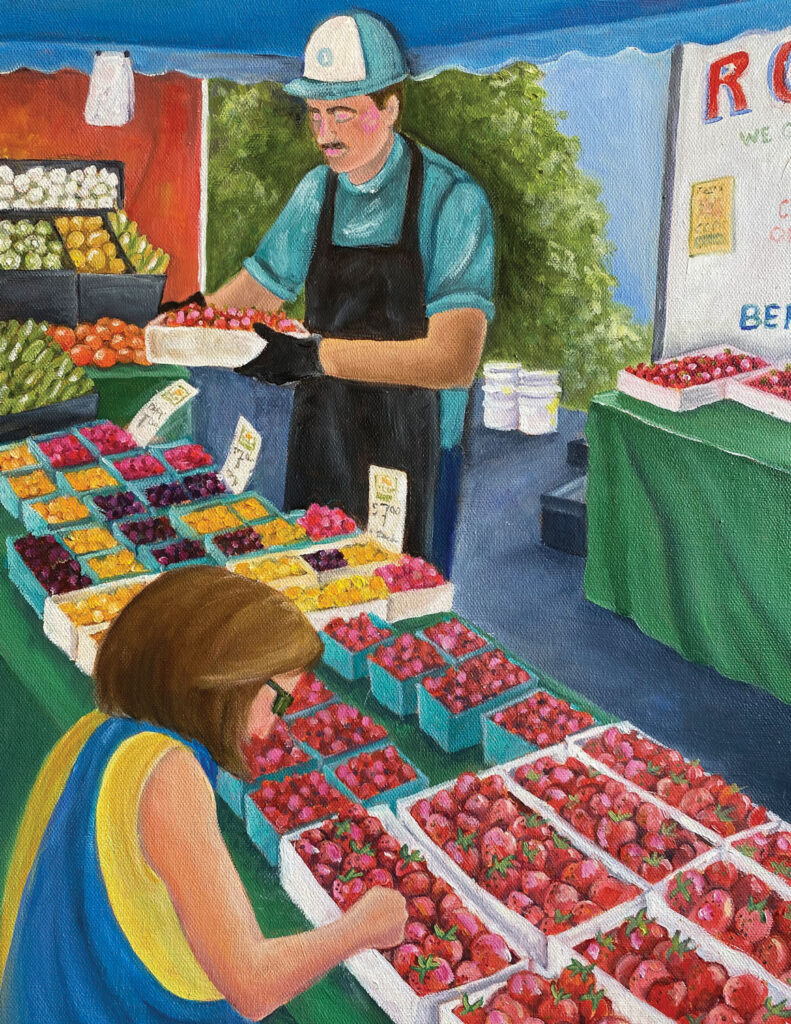
Jonathan Rodriguez was selling his second cousins Roberto and Manuel’s Albion strawberries when artist Rose Wright first envisioned this oil painting.
When Artist Rose Wright Moved to California 40 years ago, she was overjoyed by the abundant locally grown food available at the farmers’ markets. On relocating to Rossmoor a few years ago, she was pleased to discover that the 55+ community had its own small-but-mighty seasonal market.
“As an artist, I look for inspiration in the world around me,” she says. And last summer, inspiration came in the form of some beautiful Albion strawberries arrayed under the RODRIGUEZ BROS RANCH tent at the Rossmoor Farmers’ Market. “I can honestly say they are the most delicious strawberries I have ever tasted, and many patrons here would agree,” she adds.
Inspired by Rose’s passion, we phoned the Rodriguez brothers to learn more about their story and caught Roberto Rodriguez at his office in Royal Oaks (near Watsonville).
“I like to be more on the farm, but somebody has to do the paperwork, and unfortunately it has to be me,” Roberto says. He and his brother, Manuel, personally attend as many of their dozens of weekly farmers’ markets as they can and enlist family members to cover the rest, he says.
The farm’s origin story begins in the 1980s as the brothers learned to farm on their grandfather’s ranch in Mexico. “We came to Santa Cruz County from Michoacán in March of 1993 to pick strawberries,” Roberto says.
By 2001, they had their own farm of 15 acres. Now 18 acres, the original acres still host strawberries along with blackberries and raspberries. And the operation has continued to expand.
“We have a large farm in Castroville,” Roberto said. “That’s 120 acres where we grow strawberries and artichokes and some of the vegetables that need humidity like broccoli, cauliflower, celery, leeks. We have 29 acres in Gilroy, where we grow most of the carrots, beets, chard, and kale—vegetables that need the heat and also a lot of water. We have a farm in Royal Oaks with 12 acres of strawberries and nine acres of blackberries, and we also have one and a half acres of avocados in between the oaks.”
The brothers saw value in a transition to organic, so in 2005, they began the process with one acre of strawberries. “Now we are about 180 acres, and it’s all certified organic,” Roberto explains, adding that the hardest part is the transition. “You do all new inputs, and then you have to do it for three years before it’s certified organic.”
Prices keep going up, Roberto says, but organic growers have access to good organic fertilizers. To control pests, they use an array of cultural practices plus non-toxic sprays, beneficial organisms, and mechanical controls.
“For example,” Roberto says, “there is this guy we call laggis chincha [cinch bug]. We have a vacuum machine hanging in a tractor, and during the season we pass the tractor every day and suck those bugs out of the flowers.”
Roberto concurred with an observation that strawberries seemed to arrive early this year: “In a normal season with normal weather, the season is like late March to early November. This year we’ve been picking strawberries since January, and last year we stayed until December, so basically, we almost didn’t stop.”
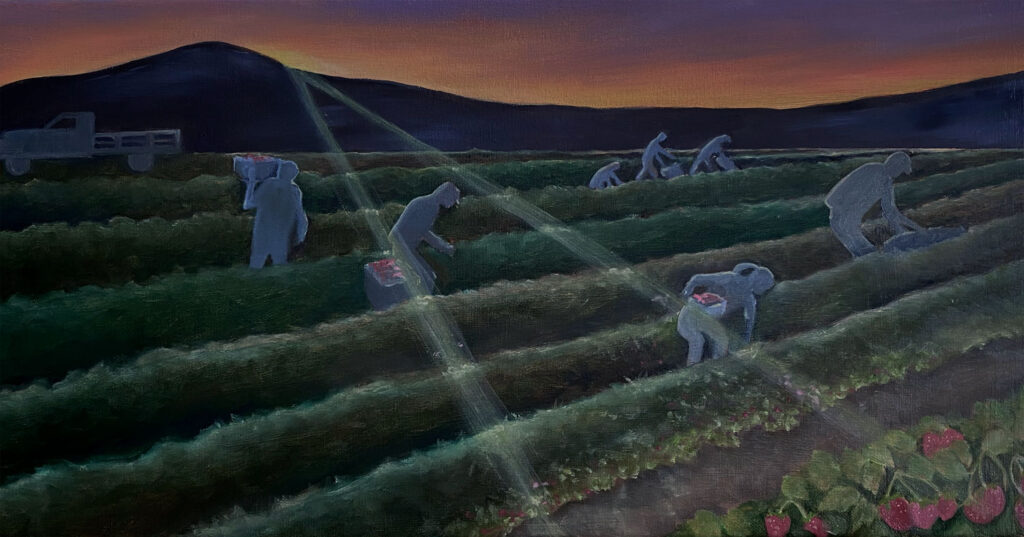
Wright conceived this scene as she sketched workers harvesting strawberries pre-dawn near Pajaro Dunes.
In February, Rose Wright and her artist friends went out on a painting excursion to Pajaro Dunes, a coastal spot about five miles southwest of Watsonville, where they saw strawberry fields stretching for miles in every direction. “Each day as we went out early to paint, we saw the field workers hand-picking strawberries,” she says. “They were there pre-dawn and still there at the end of the day.” She learned that hand-picking is how it’s done, since machines could easily bruise the delicate fruit.
Wanting to know how the strawberry workers have been faring through the ICE raids, we put the question to Roberto Rodriguez. He replied that his company has about 70 employees, and they screen applicants to make sure they have green cards, H-2A visas, or are U.S. citizens. Yet, as he explains, there was certainly a panic in July 2025 when the raids were happening around Los Angeles, and rumors of sweeps spread fear throughout their local agricultural community.
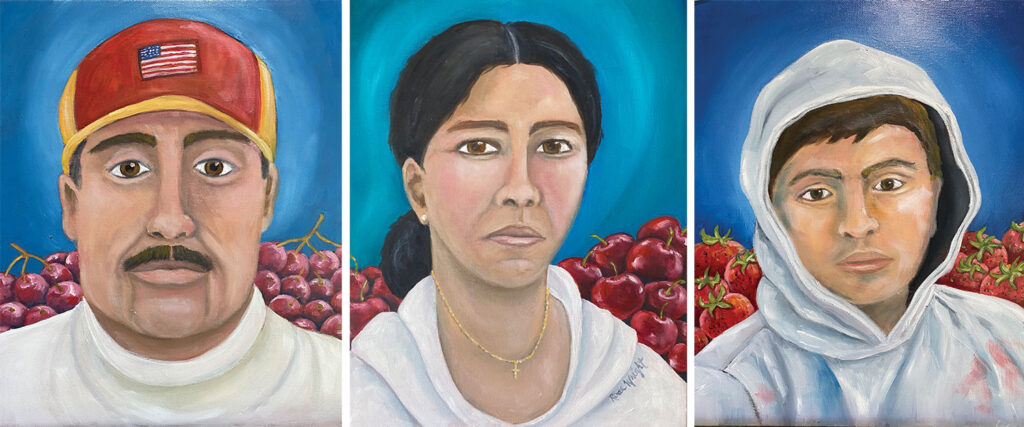
The color palette of red fruits, blue skies, and white clothing was inspired by Wright’s observations at Pajaro Dunes, where many field workers wore white clothing and hoods as protection through a long day of harvesting.
“When we were hearing about these things happening, the three counties here started educating people about how to answer,” Roberto says. The Immigrant Legal Resource Center handed out “tarjetas rojas” (red cards) to help workers understand their constitutional rights, and rapid response networks were quickly set up to help. He adds that few of their local workers were taken to his knowledge.
To close our conversation, Roberto brings up a meaningful change in his perspective that came about in 2020:
“I used to think of my job as a way to pay my bills, but during the pandemic, it was a scary thing to me when I saw people desperate for carrots from my stand, seeing what people can do when they think they won’t be able to get food. I realized that farming is a mission that we have to keep going. We don’t want to depend on our food being sent in from other countries and other states, so hopefully people realize that [when they] support their local farmers’ market or local farms, it’s a way to make our food [system] safer around here.”
Rose Wright completed her homage to the strawberry by painting the luscious-looking dessert below (with recipe). It invites the simple question: “Do we know what it took to get that beautiful fruit to our table?” ♦
Looking to learn more and take action to support farm workers?
Find excellent ongoing reporting in Cal Matters: calmatters.org
Hijas del Campo, a Contra Costa County–based nonprofit, aims to help migrant and seasonal farmworkers and their families improve daily life, working conditions, health, and safety. hijasdelcampo.org
Immigrant Defense Project: immigrantdefenseproject.org
Immigrant Legal Resource Center: ilrc.org
NorCal Resist: norcalresist.org
Rose Wright realized at age nine that art would be her calling. “It became an integral part of my life,” she says. She earned a BA in illustration and graphic design from Moore College of Art and Design in Philadelphia before the advent of personal computers and then moved into desktop publishing as she pursued a long freelance career for publishers nationwide. “After moving to Rossmoor in Walnut Creek, my focus has returned to fine arts,” she says. “I now enjoy painting subject matters important to me: mostly nature, people, and relevant topics.” rosewrightdesign.com
Cheryl Angelina Koehler is the editor of Edible East Bay
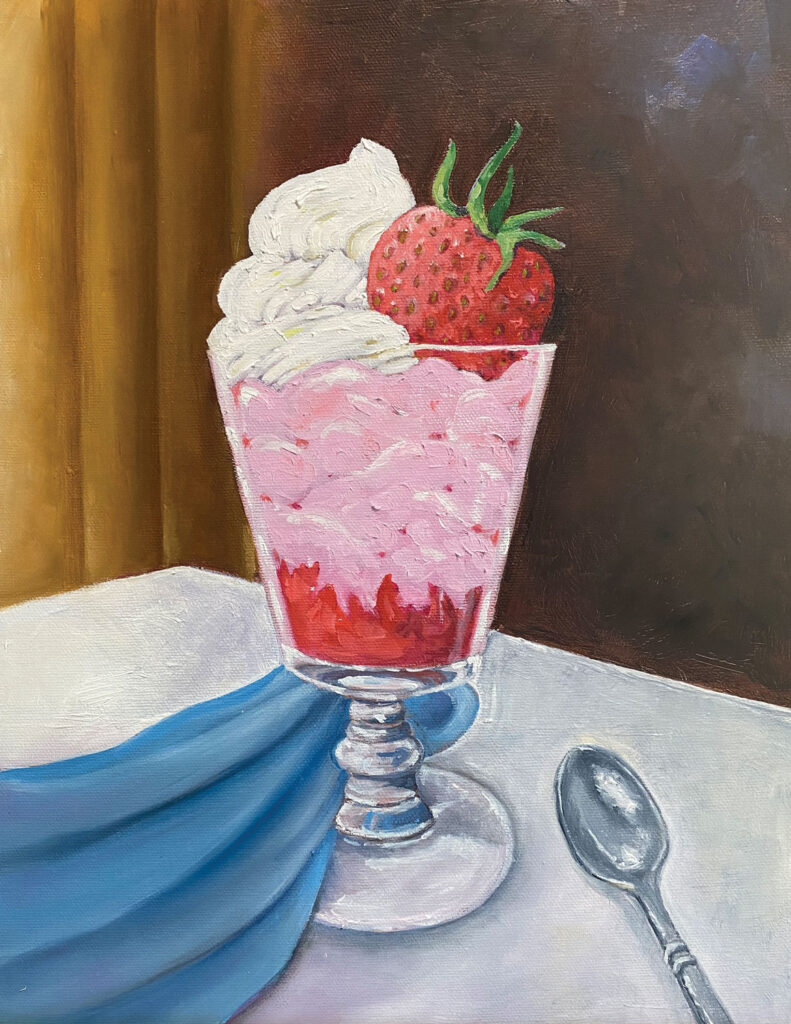
Wright made a parfait with the Rodriguez Bros’ Albion strawberries and staged the dessert on a white tablecloth to depict the beautiful fruit as it might appear at an upscale restaurant.
Strawberry Parfait with Aquafaba Vanilla Mousse
Nobody needs an introduction to the ripe-red strawberries at our farmers’ markets. Their delicious scent reaches our nostrils even before we spot their gorgeous color.
Aquafaba, on the other hand, may be a new concept. It’s simply that viscous, protein-rich liquid that forms when beans cook. All you have to do is strain the liquid from a can of chickpeas into a bowl, let the liquid chill in the fridge, and then whip it up like egg whites to become a delicious dessert topping.
This recipe was created by Cynthia Murdough, events coordinator for the Berkeley Ecology Center, the organization that runs the Berkeley Farmers’ Markets.
Serves 4–6
For the strawberry compote
- 2 cups chopped strawberries
- 1–2 tablespoons sugar
- 1 teaspoon lemon juice
- 1 teaspoon chia seeds (optional for thickening)
For the aquafaba vanilla mousse
- ½ cup aquafaba (see headnote), well chilled
- ½ teaspoon cream of tartar
- 2 tablespoons maple syrup
- 1 teaspoon vanilla extract
- 1–2 teaspoons finely grated lemon zest
Optional toppings
- Thinly sliced strawberries
- Fresh mint
- Granola
- Toasted coconut flakes
- Crushed pistachios or almonds
Do ahead: Chill the aquafaba. Also, chill some wine glasses or parfait glasses.
To make the strawberry compote: Combine chopped berries, sugar, and lemon juice and let sit 10–15 minutes until juicy. For a thicker compote, stir in 1 teaspoon chia seeds and let sit another 10 minutes.
To make the aquafaba vanilla mousse: Add cream of tartar and maple syrup to the chilled aquafaba and whip for 8 to 10 minutes until it forms stiff peaks. Fold in the vanilla and lemon zest.
To make the parfaits: Place a layer of strawberry compote, then add a layer of aquafaba vanilla mousse. Sprinkle a “crunch layer” of granola, toasted coconut flakes, crushed nuts, or all three. Repeat the layers of compote and mousse and top with a dollop of the mousse, some sliced strawberries, and a sprig of fresh mint.
Variations
Chocolate Strawberry Aquafaba Parfait: Add 2 tablespoons cocoa powder and extra maple syrup to all or half of the mousse.
Lemon-Strawberry Cream Parfait: Lightly swirl 1 tablespoon lemon curd (vegan or regular) into the mousse. Top with lemon zest.
Strawberry-Basil Parfait: Add 1 tablespoon finely chopped basil to strawberry layer. Garnish with basil leaves.
The Great Strawberry Tasting at the Downtown Berkeley Farmers’ Market
On Saturday, June 27, 10am to 2:30pm, the Downtown Berkeley Farmers’ Market at Center Street and Martin Luther King Jr. Way, is hosting a side-by-side sampling of all the different strawberry varieties their vendors are selling. Come learn about how and where the berries are grown; meet Ichigo Ichie Sweets, a new vendor with mochi-covered strawberries; check out the new, limited-edition strawberry merch; and enter the raffle. More info at ecologycenter.org.