Indigenous Cuisine Claims Its Space
Cafe Ohlone and Wahpepah’s Kitchen Creators Expand their Purviews
Story and photos by Anna Mindess
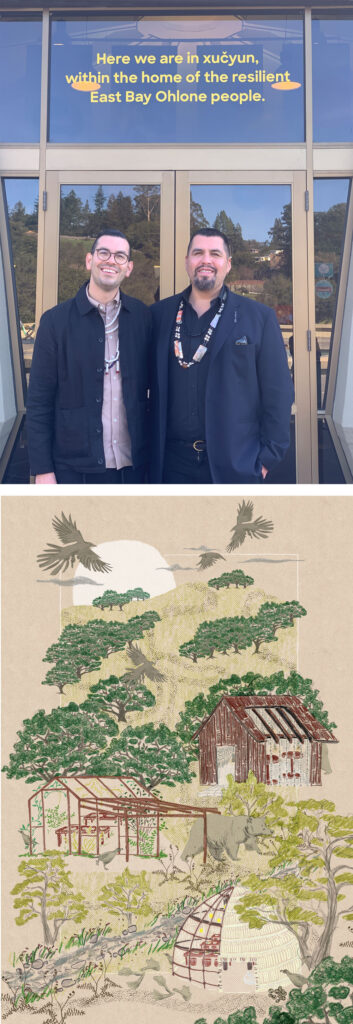
Top: Louis Trevino and Vincent Medina at the entrance to Berkeley’s Lawrence Hall of Science. Bottom: Artist Hannah Pae of Terremoto Landscape’s original renderings of the restaurants and gardens at the mak-warép Ohlone Land Conservancy’s main project in Sunol.
During the past decade, two unique, Native-run restaurants have sprung up in the East Bay: Vincent Medina and Louis Trevino’s Cafe Ohlone and Crystal Wahpepah’s Wahpepah’s Kitchen. These entrepreneurs made groundbreaking achievements as they created public venues to highlight their respective Indigenous cuisines. But as their work continues, the depth of their commitments to bring healing to 21st century Indigenous cultures and extend that into the mainstream is revealed in exciting new developments and plans.
Recently taken root on the bottom floor at Berkeley’s Lawrence Hall of Science (LHS) is Medina and Trevino’s new family friendly café, ‘ammatka, which means dining room in the Ohlone’s traditional language, Chochenyo. Here, tabletop signs share the significance of traditional ingredients cherished by the First People of the East Bay. For instance, guests learn that chia seeds (pattih in Chochenyo) convey their strength and energy to Ohlone runners, and that California hazelnuts (širak in Chochenyo) provide nourishment and basketry materials “from the same generous tree.”
The brief ‘ammatka menu of Ohlone-inspired fare includes a half-dozen sandwiches including a standout with smoked duck. Medina says that non-Ohlone diners consistently marvel over delicious treats that feature ingredients that have thrived on Ohlone lands for millennia like their elderflower soda and a whipped dessert topping flavored with candy cap mushrooms. Medina is gratified that the public increasingly associates these and other ingredients like black walnuts, hazelnuts, nettles, and berries, with Ohlone culture. “That…makes us happy,” he says. “One of the primary goals of this work is to build up understanding and respect for Ohlone people and Ohlone culture.”
Ohlone community members are gratified, too, as they find foods they eat at home highlighted at the café. “When Ohlone kids come, I appreciate how proud they are when they can see their culture represented in a restaurant that you can drop into five days a week that also has an amazing view of the Bay and the Golden Gate,” Medina says. He recalls the joy shared on his grandmother’s first visit: “She was so happy to have these foods and thought they were delicious. I know this means a great deal to the whole community.”
Medina and Trevino describe their cuisine as “Ohlone-forward.” The term denotes how they feature historically important ingredients combined with more contemporary tastes. The smoked duck sandwich, for example, features traditional, responsibly sourced poultry and house-made rose hip jam plus Mt. Tam triple cream cheese, which Medina says is enjoyed within living Ohlone culture today.
An epiphany on such modernizations came about after an Ohlone community gathering in 2017, where the organizers had intended for only old-time Ohlone foods to be served. Master baker Trevino added some chocolate to his brownies with a plan to remove it once the kids became more familiar with the taste of the traditional flour of acorns, chia, and hazelnuts. But what happened next came as a surprise: “It was the elders of the community who went to Louis and told him not to get rid of the chocolate in the brownies because they loved the two together and [felt] they could co-exist,” says Medina. “This has been a hallmark dish ever since.”
UC Berkeley’s association with Medina and Trevino has fostered understanding and respect for Ohlone people and culture across the university. Through an initiative called ‘ottoy (the Chochenyo word for repair), the Lawrence Hall of Science now weaves Ohlone culture, history, and perspective into numerous exhibits and shows. Visitors enter the newly rededicated museum under a transom where words in gold tell them that they are in the Ohlone region of xučyun.
LHS is not the first local institution to feature Ohlone culture, history, and perspective. When Medina and Trevino’s Cafe Ohlone opened in 2018, several local museums began to put Ohlone history, science, and culture front and center. The Exploratorium featured Ohlone plants, the Chabot Space and Science Center added a planetarium show called Ohlone Skies, and the California Academy of Sciences in Golden Gate Park started mounting special exhibitions that feature the Ohlone perspective.
Medina and Trevino are looking toward the future with plans to bring land back into Ohlone stewardship through the mak-warép Ohlone Land Conservancy. The main project in Sunol—where Ohlone people lived for centuries—anticipates a series of native gardens with three restaurant spaces. Medina clarifies that the groundwork was laid well before Cafe Ohlone sprang into the spotlight. “Cafe Ohlone became a platform for us to grow and expand,” he says, “but it’s an example that was set by the generations before of how to teach about who we are while also fighting to achieve more representation.” The conservancy is hoping for a celebratory event in 2027, a date that marks 100 years after the land was taken from the Ohlone.
lawrencehallofscience.org/ammatka-cafe
CHEF CRYSTAL WAHPEPAH TAKES US ALL ON HER JOURNEY
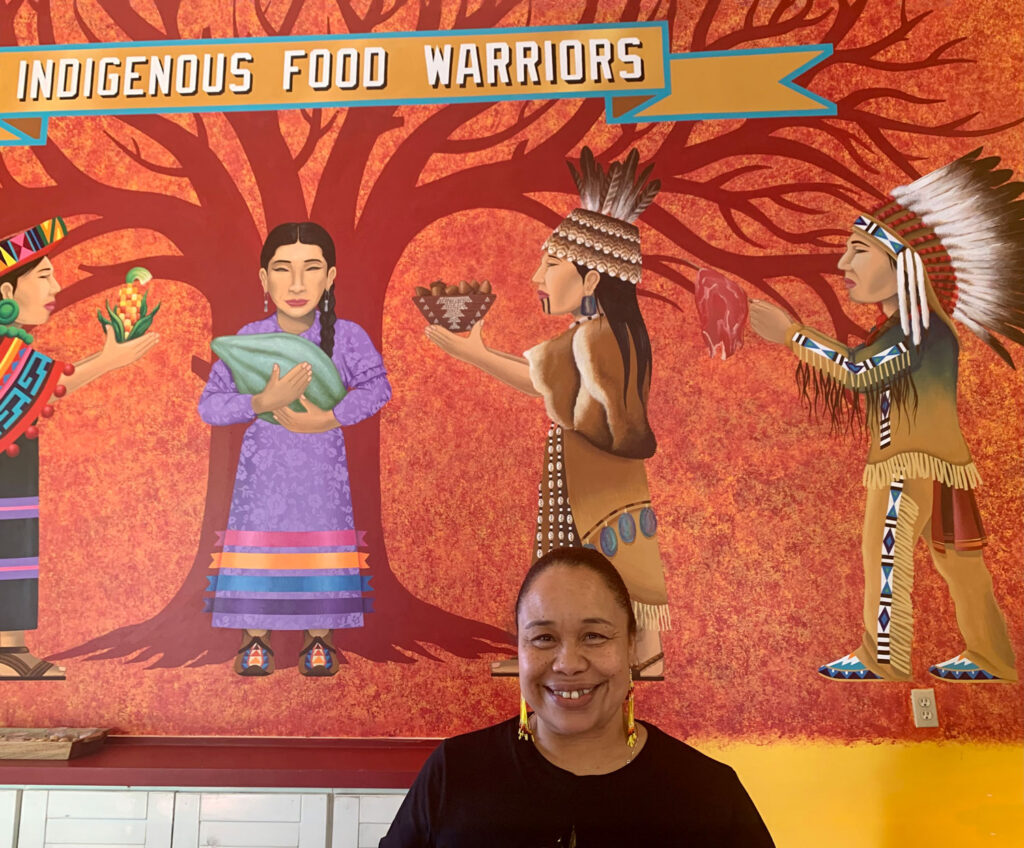
Chef Crystal refers to herself and her staff as Indigenous Food Warriors. This mural at her restaurant, created by Native art collective NSRGNTS, depicts five figures of five Native regions. Each carries a sacred food of their culture: The Kickapoo woman (center) holds a squash and wears a traditional ribbon skirt. The Mayan woman to her left brings corn, the Aymara (Peruvian) man to her right offers potatoes, and the Lakota man carries bison meat. Not visible here is an Ohlone woman with acorns and berries to honor the land where the restaurant stands.
Chef Crystal Wahpepah grew up in two worlds, and she honors them both in her new cookbook, A Feather and a Fork: 125 Intertribal Dishes from an Indigenous Food Warrior, which was published in March by Rodale Books. The chef started writing this highly personal cookbook well before the 2021 opening of her restaurant, Wahpepah’s Kitchen, at 3301 E. 12th Street in Oakland’s Fruitvale district.
Wahpepah—who is mixed race Kickapoo, Sac and Fox, and African American—was born and raised not far from her restaurant location. She began learning to cook at age seven as she mingled with Native people from around the country at the Intertribal Friendship House (IFH). Like her own ancestors, these were people who shared the experience of displacement from their ancestral lands.
In contrast to her life in that fast-moving urban neighborhood, Wahpepah spent quiet, slower-paced summers with her grandparents in Shawnee, Oklahoma. She became attuned to nature and learned to cook with the Kickapoo nation’s traditional ingredients as she helped her grandmother prepare corn for her dried corn soup and other dishes. “[Corn] holds great significance spiritually and medicinally in many tribal communities,” Wahpepah writes in her book as she introduces a dozen recipes with corn or hominy, including her grandmother’s Roasted Heirloom Corn Soup.
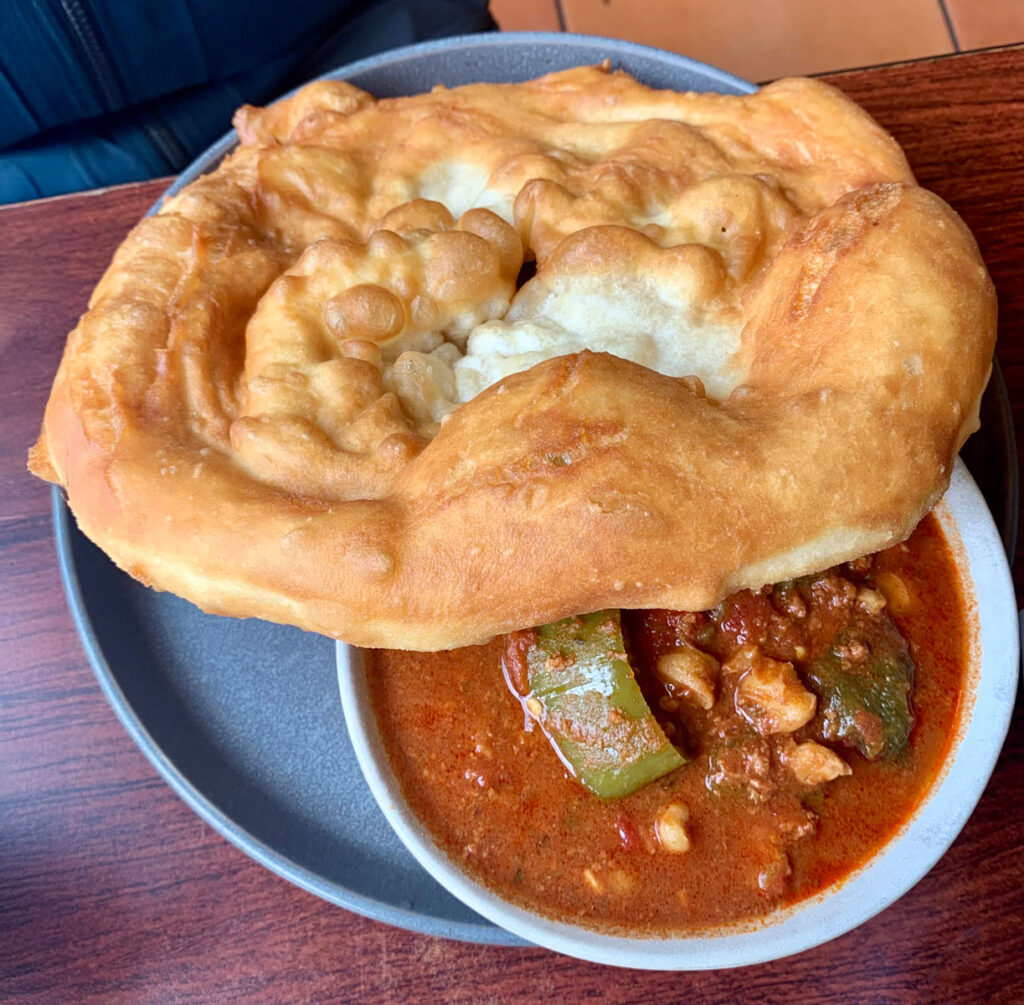 When Chef Crystal opened Wahpepah’s Kitchen, she was clear that she wanted to promote only healthy traditional Indigenous fare. She made one exception to that rule with fry bread, which represents hardship, ingenuity, and resilience for many Native people who were forced off their land and provided with only basic necessities like flour, salt, and oil. “I knew if we opened the restaurant and offered fry bread, it would overtake the whole purpose and the mission,” she says. “Same thing with the book. But I also knew I had to share the corn soup and fry bread dish because that’s a part of my family, and people should know where [fry bread] comes into the struggle. It’s a survival dish; my family survived on that, and it’s a part of who I am.”
A Feather and a Fork also offers appealing recipes like Sweet Blue Cornbread with Huckleberry Compote (see recipe below), Smoked Squash Tostadas with Green Chili Salsa, and Maple-Marinated Venison Mushroom Bites, and Wahpepah leads us to these within a framework that helps highlight their significance as she champions ingredients grown and raised by Indigenous farmers around the country and extols the foods’ healing properties. Ingredients like maple syrup; wild rice; cranberry beans; blue, white, and yellow corn; bison; and smoked salmon are cherished staples featured at her restaurant and in her recipes.
More than a collection of recipes, A Feather and a Fork conveys a moving personal story of a determined woman who persevered with the support of her family and community and who dedicated herself to helping others reclaim their identity and health through traditional Indigenous foods. For non-Indigenous readers, it provides an opportunity to discover foods grown and lovingly prepared for many generations. As Wahpepah says, “These bright, healthy, sustainable foods and foodways are truly the American diet, grown naturally, and made here for millennia.”
Wahpepah opens her cookbook with a salute to the Three Sisters, the classic combination of corn, beans, and squash traditionally planted together because the plants help each other thrive in the soil. Her section called Foraged Foods includes salads, stews, and desserts made with greens, tubers, and seeds plus her favorite food: berries. She says that picking berries has always taken her into her happiest place. The Game and Fish section includes dishes that highlight bison, venison, turkey, and fish. Side dishes feature wild rice, amaranth, quinoa, and acorn. Her beverages section includes teas made with elderberry, mint, and hibiscus.
“I want to touch people with my book because it’s not every day that an Indigenous chef shares their story and their perspective on food sovereignty and Native foodways,” says Wahpepah. “I also want to inspire the future generation of Indigenous chefs.” This second point is especially meaningful to Chef Crystal: When she attended Le Cordon Bleu culinary school in San Francisco, she was bereft of any Indigenous chef to model herself on. Now she is filling that role for the next generation.
In September 2022, Wahpepah had the honor of cooking with the James Beard Foundation at the White House Conference on Hunger, Nutrition, and Health. Other high-profile opportunities have been appearing as well. She was just named the new chef-in-residence at the First Americans Museum (FAM) in Oklahoma City, which represents the 39 tribes in Oklahoma, a position she will hold for two years as she creates their FAM’s restaurant and catering menus. “It is such an honor and a connection to my childhood,” she says.
Closer to home, Wahpepah will be opening a restaurant in San Francisco’s Mission district. The Village SF is a Native-led approach to housing and healing, conceived by the Village Project and the Friendship House Association. “This is about women in recovery,” says Wahpepah, “and my restaurant fits in perfectly, because it’s a healing treatment of our foods.” Wahpepah will oversee two floors of the new building, one for her restaurant and one for a teaching kitchen. “It will be a beautiful building, focused on health and wellness, with a farm on the roof. We dig ground in May, and the goal is to open in 2027. It’s exciting, because I get to help with the design. Of course, I’m keeping the Fruitvale restaurant; it’s coming up on our five-year anniversary in November.” ♦
wahpepahskitchen.com | friendshiphousehealing.org
Anna Mindess is a multi-award-winning food writer living in Berkeley, California, who focuses on food, culture, and travel. Her work has appeared in theLos Angeles Times, Washington Post, AFAR, Gastro Obscura, Fodor’s, and Lonely Planet, among others. Anna also works as an American Sign Language interpreter and seeks out Deaf-owned restaurants wherever she travels. Follow her on Instagram @annamindess and find her stories at annamindess.contently.com.
Sweet Blue Cornbread with Huckleberry Compote
Peeskipaateeki Methiikwaki Piipihskiihi Miinaki
By Crystal Wahpepah, excerpted from A Feather and a Fork: 125 Intertribal Dishes from an Indigenous Food Warrior
Whenever anyone asks me what huckleberries look and taste like, I always tell them a huckleberry is like a fancy blueberry. Unlike a blueberry, however, a huckleberry is small, glossy, and tart, with a flavor profile somewhere between a cranberry and a currant. The sourness of the huckleberries, served warm atop a sweet corn cake made from blue cornmeal and ancient amaranth, is tempered by the honey.
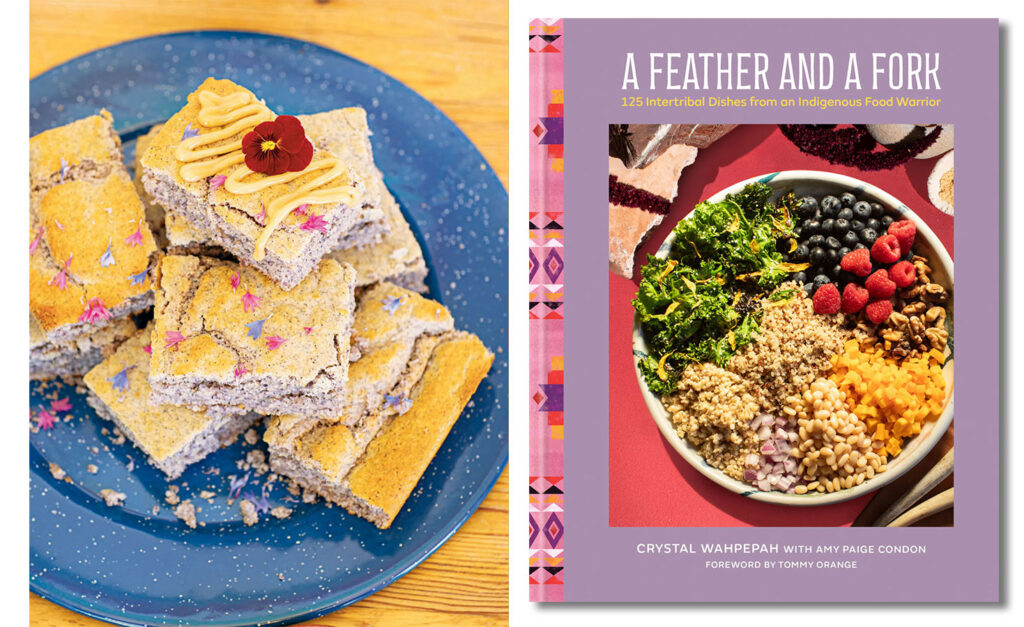
Sweet Blue Cornbread with Huckleberry Compote. Recipe and images excerpted with permission from A Feather and a Fork: 125 Intertribal Dishes from an Indigenous Food Warrior by Crystal Wahpepah, photography by Clay Williams, published by Rodale Books/Penguin Random House, text copyright © 2026 by Crystal Wahpepah, photographs copyright © 2026 by Clay Williams.
Serves 6 to 8
FOR THE HUCKLEBERRY COMPOTE
- 2 cups fresh or frozen huckleberries
- 1 tablespoon honey
FOR THE CORNBREAD
- 1 cup blue cornmeal
- 1 cup amaranth flour (see Note)
- 1 tablespoon baking powder
- 1 teaspoon sea salt
- 1 large egg, lightly beaten
- 1 cup almond or oat milk
- ¼ cup pure maple syrup
To make the huckleberry compote: Bring the huckleberries and honey to a boil in a medium saucepan over medium-high heat, stirring occasionally. Allow the berries to soften, break open, and thicken, about 7 minutes. Remove the compote from the heat and let it rest until ready to serve.
To make the cornbread: Preheat the oven to 350°F. Butter or oil a 9- inch square baking pan.
Stir together the cornmeal, amaranth flour, baking powder, and salt in a large mixing bowl. Make a well in the center. Add the egg, almond milk, and maple syrup to the well, then stir the batter together until all the ingredients are combined. (You can also use a hand mixer on medium speed.)
Pour the batter into the prepared baking pan. Bake the cornbread for 35 to 45 minutes, until it has turned golden brown and the edges have pulled away from the pan.
Allow the cornbread to cool in the pan on a wire rack for about 20 minutes before cutting it into squares. Place the squares on individual plates, then spoon the huckleberry compote over the cornbread for a sweet ending to a light meal.
Note: I make my own amaranth flour from the plants we grow at Heron Shadow. The organic company Azure Standard sells amaranth flour online at azurestandard.com and Bob’s Red Mill offers an organic whole grain amaranth flour at bobsredmill.com.
Excerpted with permission from A Feather and a Fork: 125 Intertribal Dishes from an Indigenous Food Warrior by Crystal Wahpepah, photography by Clay Williams, published by Rodale Books/Penguin Random House, text copyright © 2026 by Crystal Wahpepah, photographs copyright © 2026 by Clay Williams.