Investing in Vines
New Tri-Valley Conservancy Program Preserves the Region’s Viticultural Future
By Mary Orlin
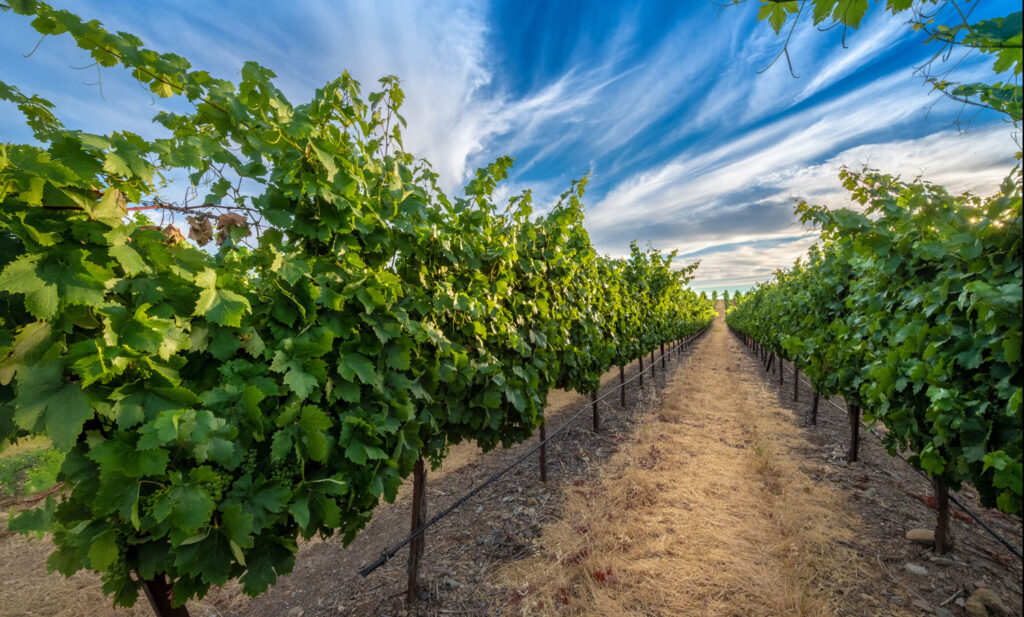
Photos courtesy of Tri-Valley Conservancy
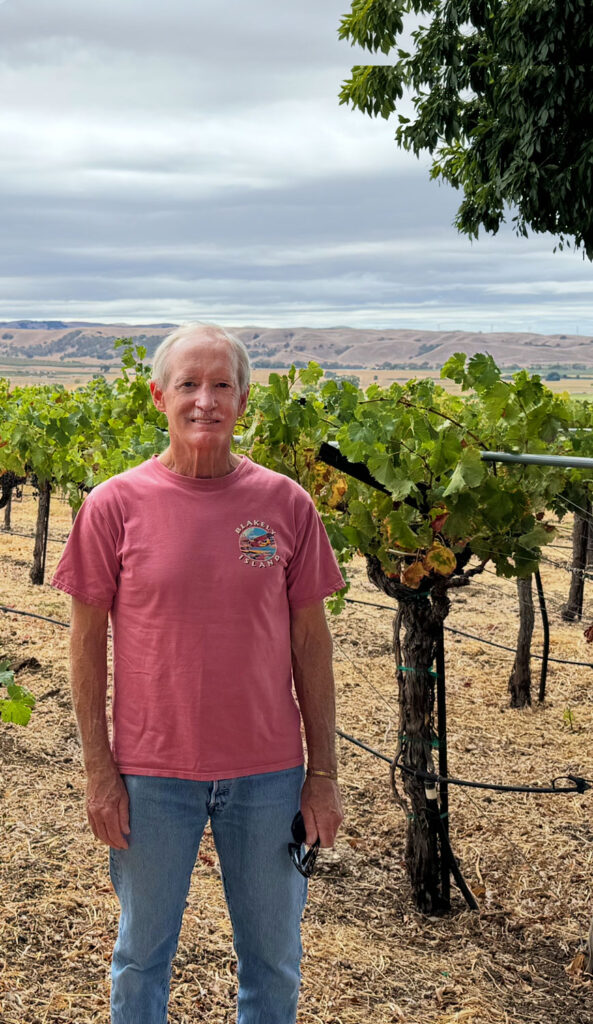
Scott Burkhart is the first recipient of Tri-Valley Conservancy’s replanting loan program. He’s seen here in his Thatcher Bay Vineyards.
Near the Altamont Hills in Eastern Livermore Valley, you’ll find Thatcher Bay Vineyards, where owner and grape grower Scott Burkhart planted merlot and cabernet sauvignon in 1991. Earlier this year as Burkhart, an engineer by trade, walked his 16-acre vineyard, he faced a decision: The vines were 35 years old, and for the past three years, he has been unable to sell a full harvest of grapes and has left a majority of the crop on the vine. “A person like myself has a choice,” he says. “I can leave the land fallow or decide to replant. You’re balancing on a knife’s edge as to what your decision is going to be.”
Through the past two years, roughly 80,000 acres of grapevines have been pulled out across California, with 300 acres of those vines pulled out in Livermore Valley alone. The reasons? As wine consumption continues to decline, growers can’t sell their crops, fruit prices have dropped, and wine sales have fallen. Wineries are adjusting to a changing market that also includes pricing challenges caused by tariffs.
But Burkhart decided to buck the trend and is now in in the middle of a vine replanting project on eight acres of his vineyard, thanks to an innovative new loan program through the Tri-Valley Conservancy (TVC). Replanting a vineyard requires a major financial investment, since the replanted vines can take three to five years to start producing grapes of suitable quality for wine. “Having a program like this helps tip it over the edge [so I can] say, ‘okay, I’ve got partners that are willing to risk this with me,’” says Burkhart.
Established in 1994, the nonprofit South Livermore Valley Agricultural Land Trust eventually became the Tri-Valley Conservancy. “Our mission is to promote economically sustainable vineyards and also increase permanently protected open space,” says TVC Executive Director Rebecca Spector.
The organization’s new Sponsored Replanting Program is a low-interest loan initiative designed to help vineyard owners remove aging vines and replant. At least 80 percent of the replanted vines must be varieties better suited to Livermore Valley, which turn out to be cabernet franc and sauvignon blanc, as demonstrated in a recent UC Davis study called Realizing the Heritage: Grape Growing and Winemaking in the Livermore Valley.
Burkhart is the first grower to receive the 15-year low-interest loan. For farmers like Burkhart, the financial support helps make a costly transition possible. “It’s still a home equity loan. It goes against the farm,” he says. “But it really helps with the cash flow when I’m not growing grapes.”
Burkhart says the loan won’t cover all of the replanting expenses. “I have to put in more to make it go,” he explains. “But it’s going to allow me to purchase many tons of steel and piping and the plants required to do this.”
“The UC Davis study identified that the region needed a critical mass of 5,000 acres in order to be established as a premier wine-growing region,” Spector says. The study also found that roughly two-thirds of Livermore Valley’s vineyard acreage is more than 20 years old and that 500 acres could be removed or replanted by 2030 if market conditions remain weak.
Livermore Valley wine leaders say the current replanting effort is focused on defining what the region can do best with its signature grapes. David Kent of Darcie Kent Estate Winery believes that this focus represents a turning point for the region.
“Let’s not plant just what out-of-area wineries need [to buy], let’s focus this time on planting what we can uniquely do better than other regions,” Kent says.
He points out that most of the vines planted in Livermore Valley between 1992 to 2002 reflected the most popular varieties driving growth at that time: chardonnay, cabernet sauvignon, and merlot. “The recent decline in per capita wine consumption over the past three years has also come largely out of these same varieties,” Kent says.
Pulling out those varieties gives growers an opportunity to let the land lie fallow and regenerate before it’s replanted with cabernet franc and sauvignon blanc. “Hopefully the Livermore Valley is ahead of the curve: Growing the emerging varietals and crafting exceptional wines from these grapes [will] help light the way for other regions,” Kent says.
Brandi Lombardi, executive director of the Livermore Valley Wine Community, concurs: “We’re looking at this decline in the wine industry as a time to take stock and revitalize and strategize for the future,” she says.
Today there are roughly 1,900 vineyard acres in the Livermore Valley AVA. “For our region to be economically viable as a wine-growing region, we need to keep vines in the ground,” Spector says.
“We would love to get 5,000 acres planted under vine here,” Lombardi says.
Burkhart took the UC Davis guidance to heart and is replanting seven acres of cabernet franc and one acre of alvarinho, a variety native to Portugal. Burkhart’s vineyard manager, Edmund Chavez, recommended alvarinho because he sees a growing interest in this white wine.
Burkhart expects to harvest his first vintage from the replanted vines in 2029. “I’ve got three different clones of cabernet franc on order with the nursery,” Burkhart says. “Those will be arriving in May or June, along with the alvarinho. I just keep being optimistic about everything, no matter how bad things look.”
In April 2026, the Tri-Valley Conservancy awarded its second Sponsored Replanting Program loan. The recipient is Concannon Vineyard, with a loan supporting the first phase of their multiyear 150-acre replanting project. That first phase will be 28 acres of cabernet franc (four clones) and 20 acres of sauvignon blanc.
At a time when many regions are shrinking, Livermore’s growers are choosing to plant again—betting that the next generation of vines will secure the future of the valley’s historic wine country. ♦
Mary Orlin is a James Beard Award– and Emmy Award–winning writer and TV producer and a WSET Advanced certified sommelier. For many years she was the Mercury News wine writer and was executive producer of NBC’s national wine show, In Wine Country. She now co-hosts a tasty podcast called Sip Sip Hooray, exploring winemakers, wine, and other spirited libations.
Six Tastes of Thatcher Bay Vineyards
Tasting notes and photo by Mary Orlin
Still A Fan of Merlot and Cabernet? We gathered a few bottles to get a taste of those Thatcher Bay Vineyards grapes in the hands of five Livermore Valley winemakers.
There’s commonality among the merlots in their vibrant ruby color, graphite minerality, intensely floral, juicy, and mouthwatering flavors, and lingering herbal and cedar notes. Price range $39-$52.
When it comes to Thatcher Bay cabernet sauvignon, the tie that binds is a savory mix of rich black fruit, graphite minerality, and notes of olive, leather, tobacco, and chocolate that adds up to a long-lasting finish. Prices in the $40s.
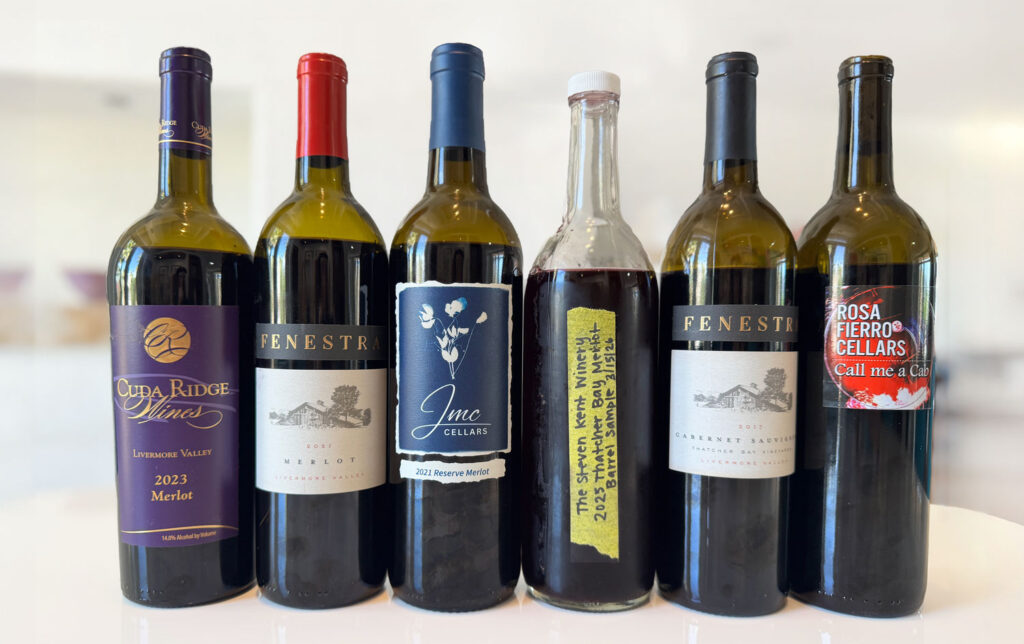
2023 Cuda Ridge Merlot: Call Larry Dino’s wine a crowd-pleaser. This blend is mostly merlot (88 percent). Beautiful violet and rose aromas entice you to sip this lively, lip-smacking wine.
2021 Fenestra Merlot: Winemaker Aaron Luna’s 100 percent Thatcher Bay merlot is bold and intense. A burst of flavor in your mouth, you’ll taste hints of mocha in the long finish.
2021 JMC Cellars Reserve Merlot, Thatcher Bay Vineyards: Seemingly subtle at first sip, the flavors and aromas open up and go boom. Jessica Carroll’s wine needs to be savored.
2025 Steven Kent Winery Merlot: We got a taste of the future as this first vintage of Thatcher Bay merlot was still developing. A wine at the beginning of its life, it is vibrant and expressive. Tannins should soften by the time it is released, which winemaker Beth Murray Mirassou estimates should be in late 2027 or early 2028.
2017 Fenestra Winery Cabernet Sauvignon, Thatcher Bay Vineyards: This wine starts with a perfumy and sweet nose of cardamom and rose that evolves into green tea, mocha, and black olive tapenade. The velvety tannins melt into the wine.
2017 Rosa Fierro Cellars “Call Me A Cab” Cabernet Sauvignon, Thatcher Bay Vineyards: You’ll want to put Rosie Fierro’s cab on repeat dial. This is the softer side of Thatcher Bay cabernets, a hedonistic pleasure.