My Great Aunt Bo’s January Gold
By Connie Mccullah, founder of Canning with Connie
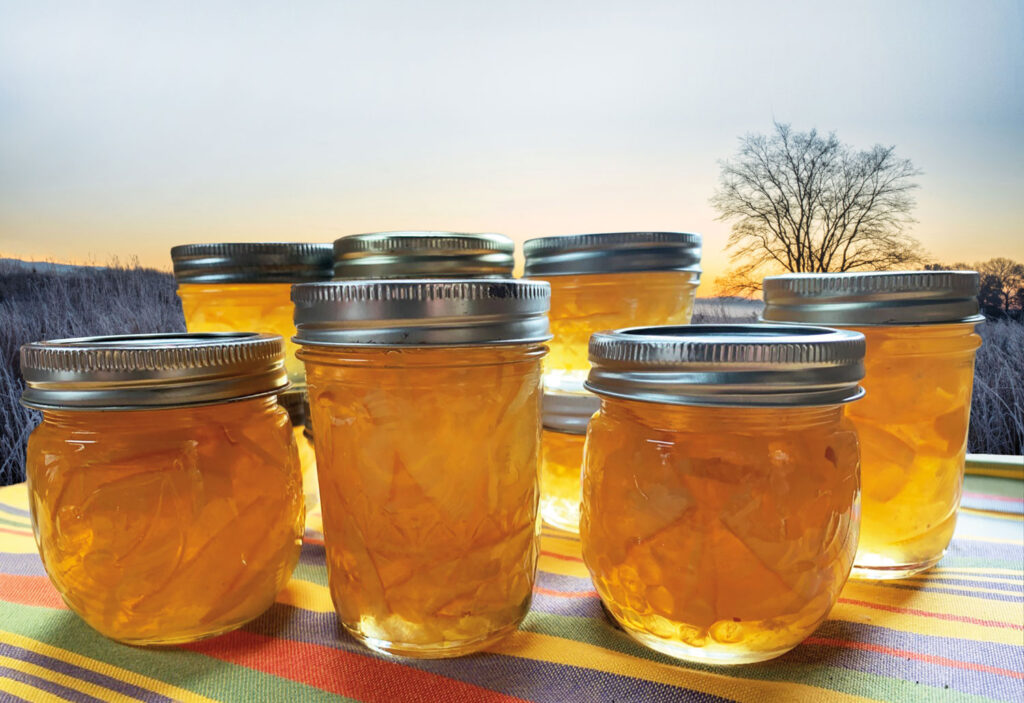
Composite photo: Jars by Connie McCullah, landscape by Tom Fisk on Pexels
In the depths of winter, as snow pressed against the farmhouse windows, I discovered a forgotten box of my great aunt Bo’s recipe cards. Inside was her marmalade recipe, complete with notes scribbled in the margins. “Oranges arrive in wooden crates,” she wrote, “their scent a promise of sunshine in our prairie winter.” She’d save precious sugar rations all summer and autumn just for this bright preserve. The preparation became a ritual: scoring and soaking the fruit overnight, carefully removing extra pith, slicing the peel into delicate ribbons.
Her first attempt in 1943 was a disaster: “Hard as amber,” she noted. But the second batch taught her patience. “Let the fruit tell you when it is ready” she advised. “The bubbles slow, the syrup sheets like silk from the spoon, and the kitchen windows steam with citrus-scented possibility.” I swore I could hear her gentle reminder: “In preserving, dear heart, we capture not just fruit but hope itself.”
Meyer Lemon Marmalade
Soaking lemon pieces overnight is a traditional step in many marmalade recipes. It helps soften the peel, release natural pectin, and leach out some bitterness from the pith. You also have the option to add the sugar to the soaking water so the fruit can absorb the sweetness overnight.
Great Aunt Bo says, “Do not double recipe!”
Yields 6 (8-ounce) jars
- 9 Meyer lemons (about 2 pounds)
- 6 cups water
- 6 cups granulated sugar
Wash the fruit to remove any dirt, debris, or wax, and slice off the ends. Quarter or halve the lemons lengthwise, slice very thinly, and remove seeds. If using a mandoline, slice onto a cookie sheet to capture the juices. Depending on their size, the 9 lemons should yield about 6 cups of sliced fruit. Place fruit in a jam pot or deep cooking pot, add 6 cups of water (more if needed to cover fruit), cover the pot, and soak overnight at room temperature (12 hours).
The next day, add the sugar and bring to a boil to dissolve all sugar. Reduce heat and cook, stirring frequently to prevent sticking, 35–40 minutes. The color and texture will change. When peel becomes translucent and the texture is like molasses, check the gel set by spooning onto a cold plate. If it pools and wrinkles when touched, remove from heat and pour marmalade into sterilized jars. Process jars for 10 minutes in a boiling water bath. Remove, cool, and label.
When not teaching, testing recipes, or gardening, Connie McCullah enjoys experimenting with produce, rediscovering forgotten recipes and preservation methods, and making connections at the Kensington Farmers’ Market. Learn more about her classes, recipes, and other offerings at canningwithconnie.com.