Start-up Businesses Get a Boost at Local Farmers’ Markets
By Rachel Trachten | Photos by Zach Pine
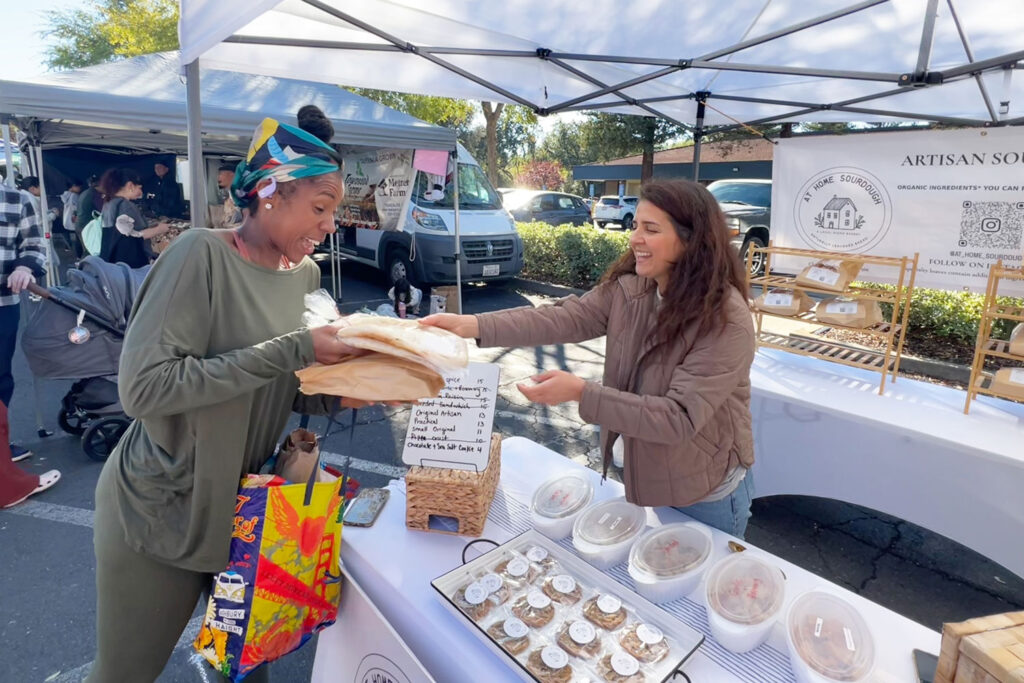
At the Diablo Valley Farmers’ Market, baker Dana Rotariu sells her sourdough bread and pizza crusts to digital marketer Chardé Domkam.
An hour before closing time at the Diablo Valley Farmers’ Market, the sausages and savory pastries at Mr. Robinson’s Authentic British Bangers are selling out fast. Mr. Robinson—first name David—and his wife, Alison, are serving a long line of customers at their booth, which is decked out with British flags and a logo of a classic British butcher. Shoppers are eager for samples and hoping to buy their favorites before everything is gone. The couple started by selling online only, but when they brought their wares to the farmers’ market in June 2025, things clicked. “We’ve seen a massive uptick in our revenue,” says Mr. Robinson.
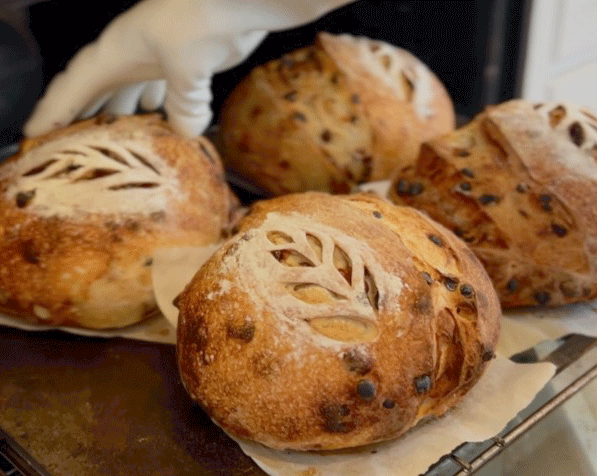
Sourdough raisin loaves are among the favorite breads made by Dana Rotariu of At Home Sourdough.
Just a few steps away, a similar scene unfolds at the At Home Sourdough booth, where Dana Rotariu is selling the last of her organic sourdough loaves, pumpkin and spice bread, and pizza crusts. Back in her native Romania, Rotariu’s mom and grandma baked with gusto, driving the family to joke about finding dough and flour everywhere, even on the handle of the home’s front gate. The baking inspired Rotariu, and after moving to the United States, she found herself giving breads away to friends and family until she found customers on Instagram and on the Hotplate app. Last June she applied to join the Diablo Valley Farmers’ Market.
“The farmers’ market has helped me build a very solid customer base,” says Rotariu. “I’m so appreciative of every person who comes in, rain or shine, and buys a loaf on a Saturday morning.”
With the prohibitive cost of starting a brick-and-mortar shop in the Bay Area, a market booth can be an ideal starting point for a new business, but there are always more applicants than available spaces. At the California Farmers’ Markets Association (CFMA), which runs 14 Bay Area markets, operations manager Warren Cox says they can accept only about 20 of 200 applicants annually. For the lucky ones that get the nod, fees are quite reasonable. Cox says the industry average for the Bay Area is $50–$80 a week per stall.
The pandemic brought many new applicants to farmers’ markets. Some were established chefs from shuttered restaurants looking for new ways to continue their trade. Others were people suddenly stuck at home with lots of free time to dream up a new food business. David Robinson took the time to invest in sausage-making equipment and try to duplicate the particular British flavors he missed. Oakland entrepreneur Stephanie De La Cruz used her new ice-cream maker to develop a flavor that tasted like the horchata her family drank at home. Dana Rotariu turned her baking skills to the art of sourdough.
How Does a Vendor Qualify?
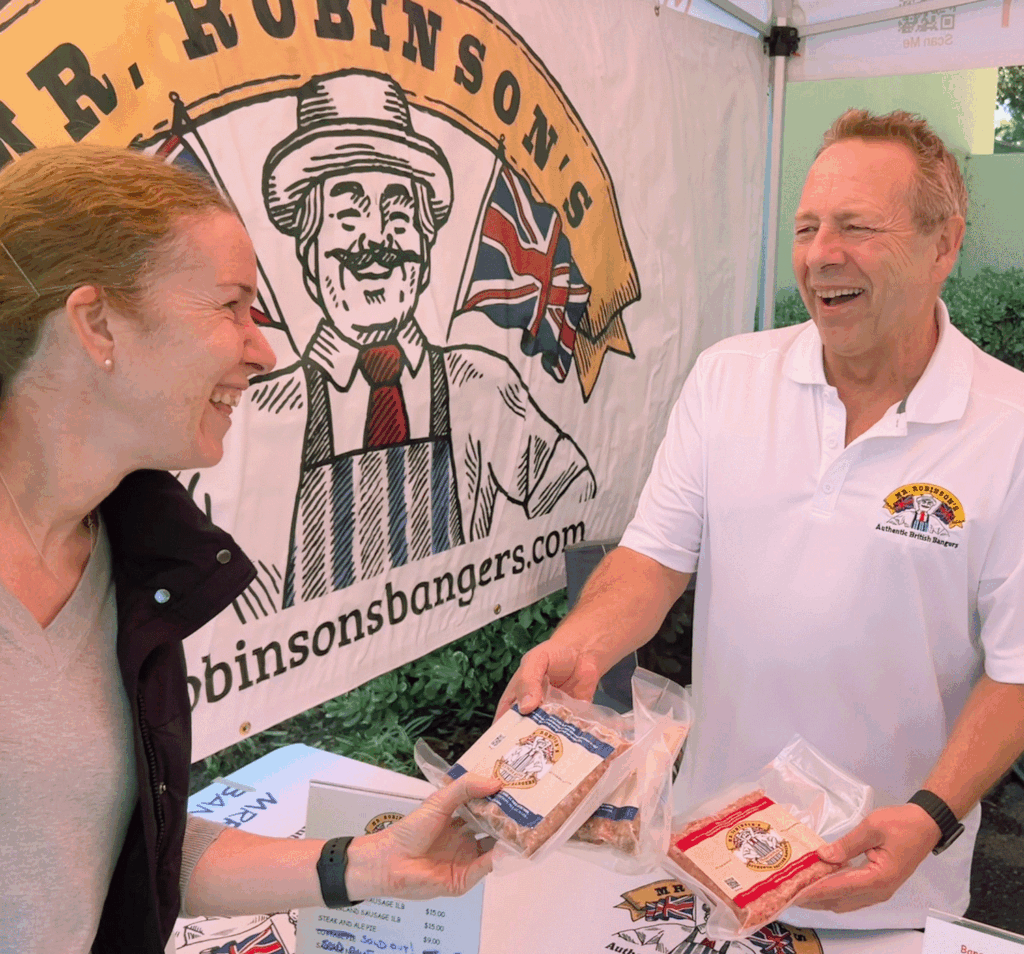
Farmers’ market shopper Lisa Heatherington, from the United Kingdom, jokes with David Robinson as she purchases a supply of British bangers. The colloquial category of bangers includes many different regional sausage varieties.
Market managers evaluate applicants in various ways: How delicious is the product? How will it fit with a particular market and its customers? Is this vendor ready to sustain a weekly booth? Cox says they try to avoid having two vendors selling similar products, but sometimes it’s the other way around and his team needs to fill a particular niche at a market, such as finding a bakery to replace one that left. For instance, when Daniel McChesney-Young, manager of the three Berkeley Farmers’ Markets, was in search of an ice cream vendor, he reached out to Stephanie De La Cruz, whose Mexican-inspired ice cream was already a hit at pop-ups held at Tacos Oscar. De La Creamery’s horchata and Mexican chocolate flavors quickly became favorites at the South Berkeley market.
“Farmers’ Markets are great places for new concepts, but we usually look for businesses that have taken a few steps already,” says McChesney-Young. “We require that our vendors have a health permit and a commercial kitchen or cottage food license. If they’re not there yet, we’re able to point them in the right direction, but we usually don’t have the capacity to sit down and help them fill out the forms.”
To help ensure that new vendors are successful, CFMA market manager Warren Cox oversees vendor juries with other market staff: “We take the time to meet with [applicants], discuss the business plan, test their products, and discuss what it takes to join a market—not just permitting, but the staffing and equipment. A lot of people who are launching a brand-new business haven’t fully thought through a lot of that.”
Cost and pricing are key too: “It’s really important for new business owners to pay themselves,” says Cox. “You can’t run a sustainable business if it’s only going off your free labor. Eventually you’re going to burn yourself out or you’re going to need help.”
Samples, Name Tags, and Awnings
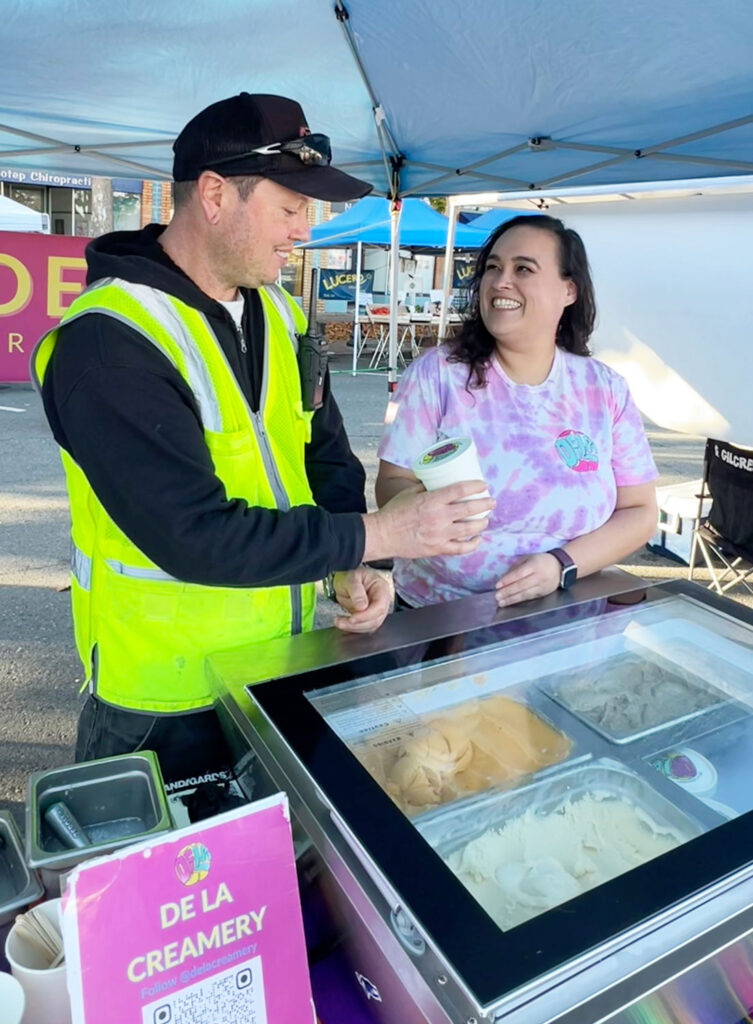
With help from South Berkeley Farmers’ Market manager Daniel McChesney-Young, Stephanie De La Cruz turned a passion for making horchata ice cream into a successful business.
Beyond helping with basic setup, market teams help new vendors get fully on board. For example, when De La Creamery started at the South Berkeley market, no one had anticipated the hot August sun. “They helped me find a spot without direct sunlight and quickly move my setup in the moment to continue selling,” De La Cruz recalls. Getting an awning was helpful advice for Rotariu as well, as was wearing a name tag.
For David Robinson, one word made a big difference for his business: “Samples.” It helped him introduce American customers to a new product while also offering British, Irish, and Australian shoppers a nostalgic taste of home. The result of all that sampling? “Every week we run out of samples, and we also run out of product,” Robinson says.
At the Kensington Farmers’ Market, manager Chris Hall helps new vendors by introducing them to customers via his newsletter. At all markets, vendors can also benefit from collaborating with one another, such as when De La Creamery made seasonal sorbet with Kashiwase Farms peaches. Customers help out too, offering useful feedback on taste, variety, packaging, and other factors.
A few lucky vendors get to take part in the Food Maker Incubator Booth, run by the Agricultural Institute of Marin (AIM). “The Incubator is designed for beginning food makers that have never been in farmers’ markets before,” says Jenna Smart, AIM’s director of programs and community impact. “They want to try and see if this is a good realm for their business model, whether they’re making hot food, prepackaged food, or baked goods.” This program, currently in Marin County only, removes financial barriers by covering stall fees for a year and paying a stipend for business expenses. It offers technical assistance and peer mentorship and also rotates among three markets to give vendors different experiences.
The Leap into Bigger Markets
Selling directly to customers at a farmers’ market booth has many advantages, like reducing overhead and building brand recognition. It’s also a way to test the market for business expansion. After starting out at farmers’ markets, initially homespun businesses Bolani flatbreads, Anne’s Toum (a Lebanese garlic dip), Farmor’s Dressing, and Summer Solace (skincare and candles) now have their products on local shop shelves and even in some national markets.
Expansion might also mean a shop of one’s own. Kensington Farmers’ Market manager Chris Hall recalls feeling skeptical when Uli Elser approached him with the idea of selling his German pretzels there. “To my surprise, people really like pretzels and kids love them,” says Hall. “They did so well that, presto, Squabisch has a storefront on Solano.” ♦
INCUBATORS ABOUND
The Bay Area has a good crop of food business incubator programs that offer much more help than a farmers’ market can provide. These programs are able to offer a free-to-low-cost foundation with business advice, skills training, kitchen space, networking opportunities, and other supports.
The Bread Project: Early-stage food entrepreneurs get production support, food safety training, recipe scaling, business guidance, and access to certified kitchen space. breadproject.org
La Cocina: Addresses problems of equity in food business ownership for women, immigrants, and people of color through affordable kitchen space, training, resources, and community. lacocinasf.org
East Bay Small Business Development Center: The Restaurant Program provides no-cost services to people who own an existing restaurant or food business or need support for their startups. eastbaysbdc.org
Food Maker Incubator Booth: supports emerging food-based entrepreneurs from West Marin, Marin City, San Rafael’s Canal neighborhood, and Southern Novato, reducing key barriers to entry into AIM (Agricultural Institute of Marin) certified farmers markets. agriculturalinstitute.org/food-maker-incubator-booth
Forage Kitchen: Offers shared workspace, business support, and a community of like-minded chefs. foragekitchen.com
Kitchen@812: Provides business education, workshops, and the space and support to test, launch, and grow a food business. kitchen812.org
Mandela Partners: Their E14th Eatery + Kitchen program uplifts local food entrepreneurs of color by providing access to selling opportunities. e14theaterykitchen.com
Oakland Bloom: Helps poor and working-class refugee, immigrant, and BIPOC chefs to launch their own food businesses and to reshape what a healthy and just food service industry looks like. oaklandbloom.org/programs
Renaissance Entrepreneurship Center: Professional training, expert consulting, access to capital, and a vibrant support network for entrepreneurs who want to start or grow a business. rencenter.org/renaissance-incubator
Writer Rachel Trachten and photographer Zach Pine always enjoy the chance to explore local farmers’ markets and come home with tasty new foods. Read Rachel’s stories at clippings.me/users/rachel_trachten and learn about Zach’s environmental art projects at zpcreatewithnature.com and sandglobes.org.