The Fermenteria
By Jeremy Oldfield
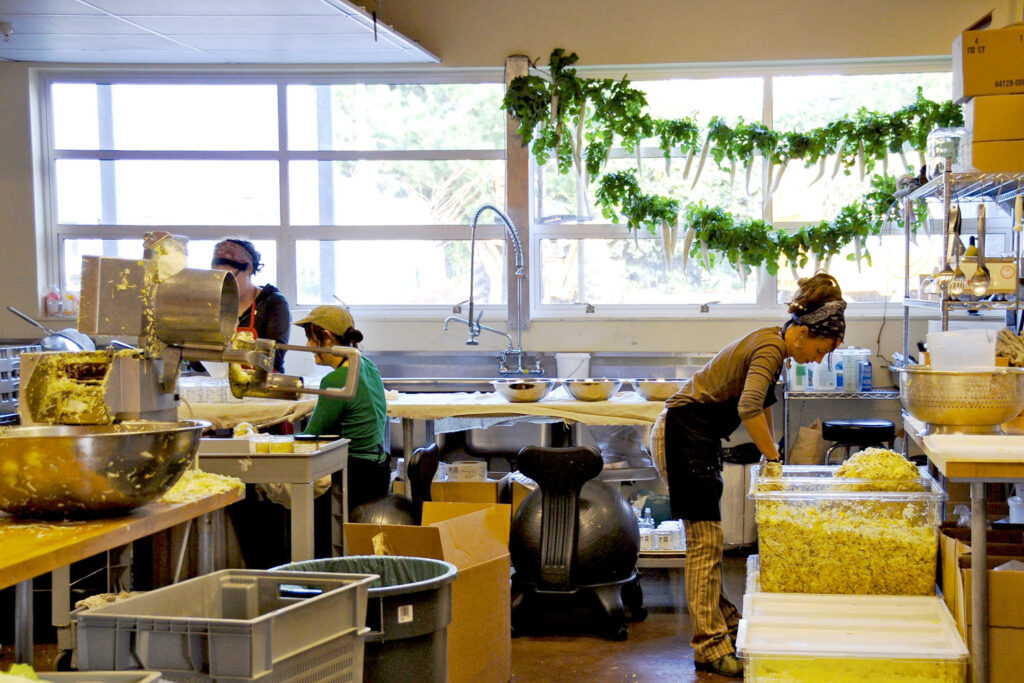
So many pickles, so much time. That’s become a motto in my slow, savored quest to test drive every variety of raw sauerkraut, kimchee, and specialty pickle from the Cultured Pickle Shop. Recently, I’ve been going purple: A “Super Sauerkraut Salad” of cabbage, beets, carrots, and ginger has been garnishing my mesclun salads, open-faced sandwiches, even spaghetti bolognese! Whom can I thank for this added dimension of ruby piquancy on my kitchen table? Master fermenter Alex Hozven. Her store in West Berkeley is a landscape of stainless steel, ’80s music, and active, tangy scents.
 Here, Hozven continues her 12-year venture into the endangered foodways of live-culture vegetables, condiments, and beverages. Her 10 sauerkraut varieties include a classic Original Cabbage recipe, yellow curried Khichari Kraut, speckled green Sea Kraut, cayenne-red Kim Chee, caraway-infused Vintage Kraut, and a “Shoo Flu” concoction made with warm spices and green tea leaves, and studded with goji berries.
Her “Seasonal Specialty” varieties change throughout the year like a Chez Panisse menu. “I make these pickles in a very particular interaction with Northern California produce,” said Hozven. She sources her vegetables from local, organic farms, including Riverdog, Avalos, and Full Belly. “I think that’s so important in the slow food movement: to make it very place-specific. I’m pickling in a way that involves my local environment.” This fall, expect the Seasonal Specialties to focus on root vegetables, like a red turnip kim chee, beets with fennel, and purple carrots with red onion and dill.
A “live-culture” process employs beneficial microbes to preserve, enrich, and bestow unique flavor to food. Hozven utilizes lactobacilli bacteria already present on vegetable surfaces to convert their sugars into a cocktail of healthful and preserving acids. For this to happen, the veggies are submerged in a salty brine to inhibit decay and then covered and monitored as probiotic activity works its alchemy. No vinegar or heat is involved. “Vinegar pickling,” says Hozven, “is more of a modern shortcut. The conversion of sugars into acids is an ancient process. The live-culture pickle is definitely the oldest pickle.”
The oldest pickle is also the medicinal pickle. Live-culture processes increase vitamin levels, promote healthy intestinal flora, and aid in digestion. The Weston Price Foundation (westonaprice.org) reports that foods like sauerkraut are enzymatically active and exhibit antibiotic and anti-carcinogenic properties as well. Such foods are ubiquitous in pre-modern cultures, where refrigeration is limited and people rely on simple foods for complex nutrition. Go back only a century or two, and chances are your own ancestors were partaking in several traditional ferments. Many, such as cheese, wine, yogurt, sourdough bread, miso, kraut, and kimchee, still persist in our diet.
More than a century ago, pasteurization techniques, developed for industrial food production, dealt a deathblow to American live-culture consumption. The hit was both economic (pasteurized pickles became cheap commodities) and cultural (“Fear the microbe; he is always an enemy!” became a national mantra). Commercial canning rapidly replaced traditional ferments in markets and pantries. Vinegar-based, heat-treated pickles (which offer none of the aforementioned health benefits) became our sandwich-sidekicks and burger-toppers. Raw, probiotic pickles and condiments flirted with extinction from the American table.
Okay, cue Hozven. Twelve years ago, pregnant with her first child, she began experimenting at home with her first batch of sauerkraut. “I was craving a lot of sour foods,” she recalled. “I think your body is really craving live-culture foods at that time.” Since then, her fermenting project has bubbled and fizzed, so to speak, out of her home kitchen and into an old warehouse space at Fifth and Bancroft in West Berkeley. Her client base has risen to include shoppers at the Tuesday and Saturday Berkeley Farmers Markets, as well as those who pick up her products at many Bay Area grocery stores and regional Whole Foods Markets.
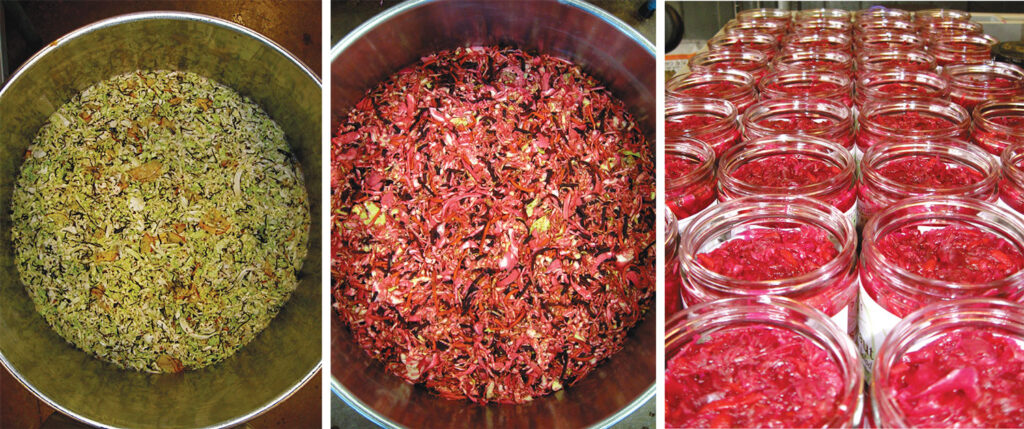
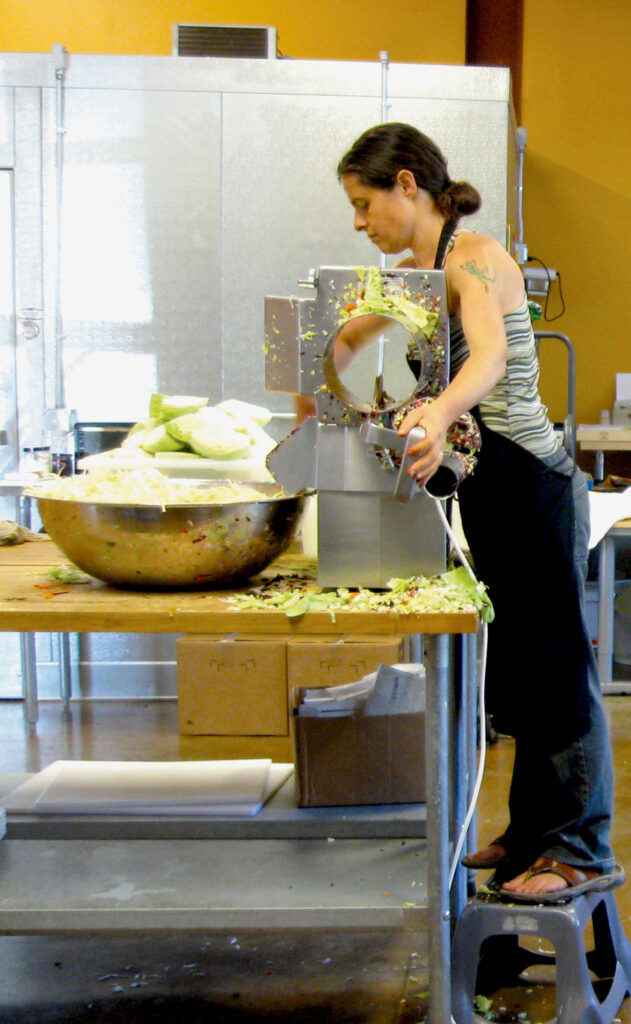
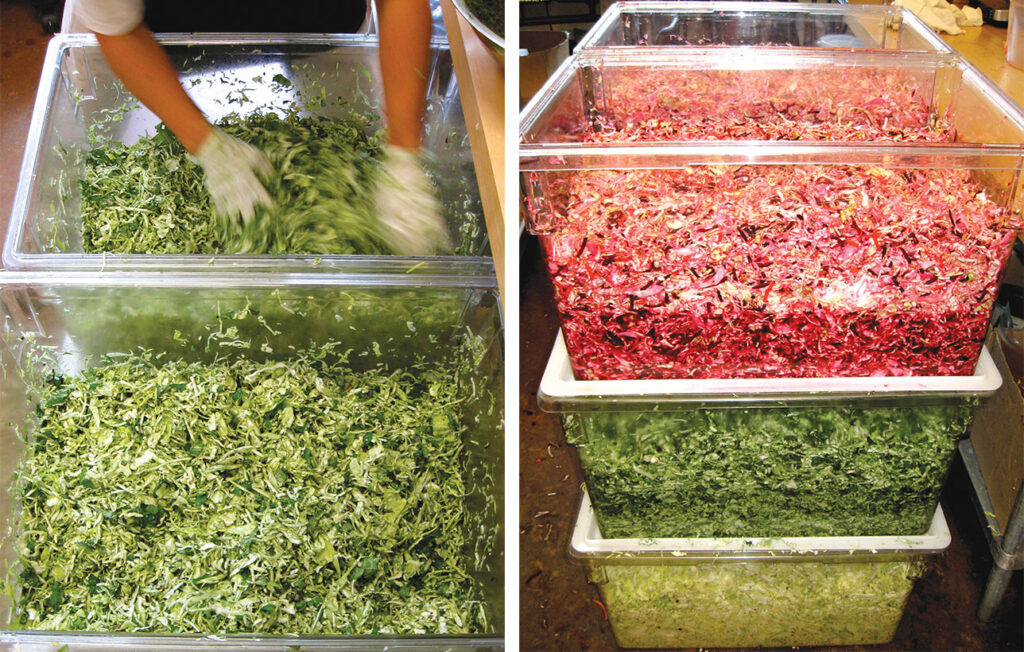
Hozven’s original stoneware crock has grown as well: It’s now a legion of 30-gallon stainless steel drums originally built for wine production. She and her crew of four employees chop and shred piles of local cabbage into plastic tubs, then “massage” salt and seasonings into it. They pack the slaw-like mixes into the sleek drums to ferment for six weeks in “the Cave,” a climate-controlled chamber. Just breathing this chamber’s pungent air feels like a detoxifying act. Standing there, with 50 drums silently fermenting, 50 valves regulating pressure and air flow, and fifty note cards listing each batch’s specific timeline, I began to appreciate the artisanal science of it all. Before we left, Hozven sampled a Seasonal Specialty for ripeness, altered the pressure of certain drums, and then wheeled two out for their contents to be hand-packed into jars.
Recently, Hozven added kombucha to her sales shelf, giving this popular probiotic beverage her own vegetable spin (carrot, celery, beet, and fennel are her four main flavors). In a mosaic of five-gallon jars, she inoculates sweetened green tea with smooth, pancake-shaped “scobies” (solid microbial colonies that have ancient, and seemingly mythical, Eastern origins). The tonic effervesces for two weeks before she adds raw local honey and fresh vegetable juice. This ferments in smaller glass bottles until it’s fizzy. A bottle of carrot kombucha turned luminescent orange as she shook it to give me a try. The earthy carrot juice had mellowed the tea’s spritzy tang, and there was something very rounding about the fermented honey.
“Is there anything more sacred than fermented raw honey?” sighed Hozven. In addition to its abundance of trace minerals and antibacterial properties, raw honey is probably the most concentrated enzymatic food available. “If you think of local honey as an amalgam of billions of nearby flowers—many of them wild, many of them medicinal—then consuming it becomes a way to connect with your local ecosystem on a microbial level. Add to that the alchemical process of fermentation…” she just shook her head in reverence.
Consider the Cultured Pickle Shop as a seed bank of ancient food-storage methods. “In the same way that we’ve started preserving heirloom seeds,” said Hozven, “there’s also an idea of preserving heirloom processes. Part of what I love about these really obscure ferments is that they are such interesting historical processes, and you have to preserve processes just as much as you have to preserve plants, because they die out, too.”
Take takuan, an heirloom Japanese pickle often found on the store’s shelf. Root vegetables ferment slowly in a bed of rice bran, the by-product of rice milling. The bran imparts a concentrated flavor to the roots. “There’s definitely some umami going on there,” smiled Hozven’s husband, Kevin, as I sampled a thin slice. He was referring to that all-elusive “fifth taste” that only Japan has a word for (and that live-culturing can sometimes unlock). Similarly, kazuzuke is a method of pickling vegetables in the pasty, aromatic dregs of sake production. Cultured buys local dregs at Takara Sake, just four blocks from the Pickle Shop. Imagine that: “waste” streams redirected toward gourmet fermentation. This may be a general theme among heirloom processes: their pre–gas pump über-sustainability. Converting local by-products into sophisticated nutrition is a frontier we can afford to explore today.
Now, I did not grow up with the regular zing of live-culture condiments on my table. When I bought my first jar from Cultured (Sea Kraut, it was), I took it home, opened it, and went at it with a fork. Two bites later, I was done. Satiated. Soured out. It wasn’t until I dropped in on lunch hour at the Pickle Shop that I learned a thing or two about incorporating sour into my diet. A large bowl of salad sat on the table, topped with a Seasonal Specialty of pickled radish, fennel, and turmeric root. Sourdough toast was being slathered with peanut butter, then topped with… kraut? I blinked. It was Shoo Flu kraut. PB&K! With Kevin’s nearly evangelical encouragement, I stopped hesitating and partook in this odd gastronomic pairing. Pow! The kraut’s effervescent crunch brought the sticky comfort of peanut butter into technicolor. A probiotic peanut butter sandwich?! It’s become a regular two-minute snack in my apartment.
A quick survey of Cultured employees yielded a range of favorite pickle uses. Tossing forkfuls of Super Sauerkraut Salad with a mesclun-based salad is a universal favorite (hold the vinegar—the kraut takes care of the tang-factor). Vintage Kraut and sausage gets a strong endorsement, as does Khichari Kraut with eggs and potatoes for breakfast. Kim Chee “takes stir-fries to the next level,” claimed one employee (add it after cooking), and Lemon Garlic Dill delivers complex zest to cheese and crackers.
But Hozven abstained from giving me specific recipes to use with her pickles. “I really try and get people out of a formulaic way of doing things,” she said. “I mean, take parts of India, or Korea, or rural China: In general people eat very simple diets. They eat rice, and maybe some lentils. And the way that becomes okay for you, is you have a lot of different condiments: You have your chutneys, or your kimchees, or maybe your pickled mustard. It’s okay to eat really simple foods, as long as you have fun condiments. You get to the point where you’re eating really concentrated foods, and you don’t need to eat that much of them. You’re really getting everything you can out of what you eat. I think, when we talk about scaling down lifestyles, eating simply has to be on there. It’s all about what condiments you use.”
When you start to regard them as condiments, Hozven explained, Cultured’s products become extremely versatile. “Start eating them regularly with your salads or whatever you’re having for dinner. Open them up and try a couple of them and just eat it like a zingy side dish. You don’t always need to mix it this way or pair it that way. Just eat it. And once you start to eat it, you’ll understand. Once you start eating it, it will just become another food group for you.”♦
Cultured Pickle Shop
800 Bancroft Way, Suite 105, Berkeley
culturedpickleshop.co
Author’s note on biological eating
We might think of nourishment in terms of “chemical eating” versus “biological eating.” For example, if you come down with a cold (or, ahem, a hangover…), the chemical approach might be to reach for an Emergen-C. The biological approach might be to reach for a kombucha. The first offers inert compounds our immune system can utilize. The second delivers vitamins and acids to our immune system, and several billion microorganisms to our gut that aid nutrient assimilation. Chemical eating gives us basic (and often synthetic) building blocks for health; biological eating gives us building blocks and an ideal habitat for building. “If you create the right habitat,” says Hozven, “even though you might get bits of damage here and there, you’re still going to have a healthy system.”
Organic farmers utilize this “biological eating” approach in growing healthy food. Their agricultural methods are based on inoculating soil with a nutrient-dense ecosystem of microbial actors. Beneficial microbes engage in a type of barter with the roots of organic crops, providing nutrients and even medicines in exchange for tiny drops of sugar water. Conventional farmers go the “chemical eating” route, fertilizing their fields with inert compounds like potash and ammonium nitrate. Eating biologically—that is, including live-culture foods in a nutritious diet—is the gastronomic equivalent to organic farming. Doesn’t this seem like the next rational step in our dietary sensibility?
Jeremy Oldfield co-founded the Freelance Farmers, a company that designs and installs residential kitchen gardens in the Bay Area. He also authors their blog, “Not Another Food and Farming Blog!”