
Seafood Salad with Sauce Créole
Story and recipe by Niloufer Ichaporia King | Photos by Clara Rice

Niloufer Ichaporia King’s Seafood Salad with Sauce Creolé is surrounded by David King’s 2008 and 2025 menus for the Parsi New Year dinner at Chez Panisse.
Every year on March 21 we have a dinner at Chez Panisse to celebrate the ancient Persian New Year, now known generally as Noruz, or by the Parsi community in India as Navroz. The menu is drawn from my Parsi heritage. We’re the people who fled Persia around 1,000 CE following the fall of the ancient Zoroastrian empire to Islam. We landed on the west coast of India and got absorbed into the fabric of that country. One thing that characterizes the food of my community is how outward looking our kitchens have been, absorbing every appealing influence. We love our own food, an amalgam of the Persian foodways we brought with us: the food of Gujarat, where we first settled in India; the food of other places in India; and indeed the food of anywhere and everywhere.
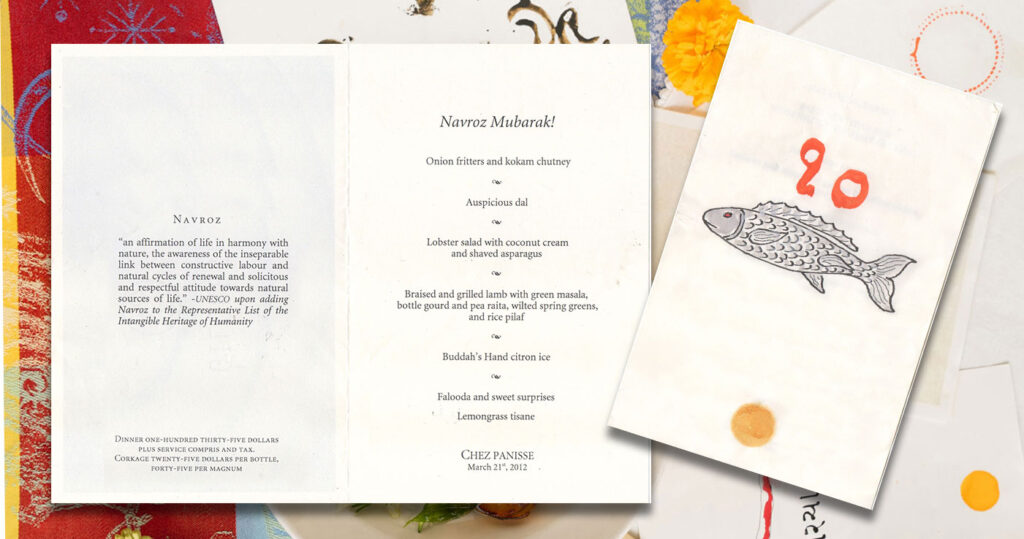
Niloufer Ichaporia King’s husband, David King, creates a new menu design each year for the Chez Panisse Parsi New Year dinner. The 2012 menu included UNESCO’s definition of Navroz. The menu cover from 2006 featured a fish.
When I travel, the best trophies from any trip are a new taste, a new ingredient, a new tool, a fresh look at something familiar. Sometimes these souvenirs can weigh a lot and sometimes they’re an idea like this particular travel treasure from the French West Indies. It was taught to me by Joséphine, the cook at the Hotel Hajo on the island of Marie Galante. From our very first taste of Sauce Créole, it was our favorite thing, in our top five category of tastes that beget greed. We first had it on thin slices of grilled eggplant, and this is something we return to over and over.
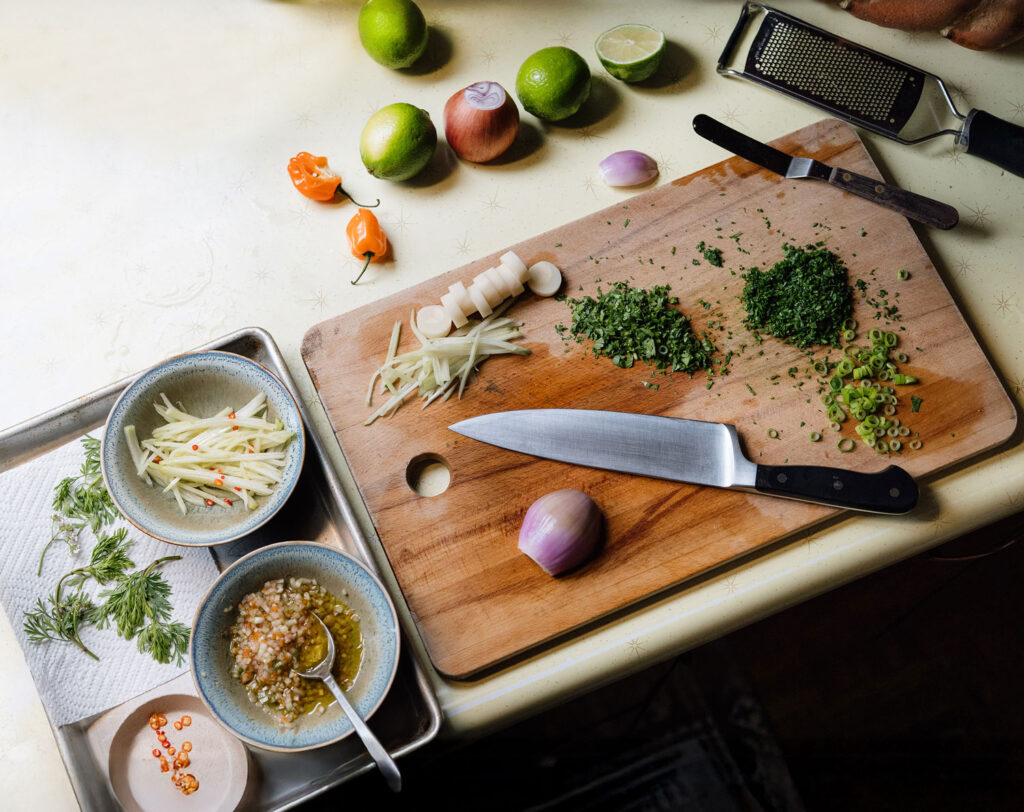
Chef Rebecca Stevens prepared the sauce creolé and a chayote slaw for the recipe photography.
For our 2025 Chez Panisse Navroz dinner, I thought we could do something with Sauce Créole for our fish course. The great delight of these annual dinners is working out the menu with Amy Dencler, downstairs Chez Panisse chef and a beloved pal in and out of the kitchen. We’d been given some Bondolio olive oil that had been milled with Hatch chiles and thought we could use this to good effect in the seafood course.
We worked out a salad of prawns and squid seared on top of the stove and dressed with Sauce Créole. You could also use swordfish, tuna, or chunks of lobster, but Sauce Créole is dramatic and exciting with just vegetables. At home, we always serve it with thin slices of grilled eggplant, the way we first experienced it and still our favorite way to serve it.
For the Sauce Créole
Make more Sauce Créole than you think you’ll need, doubling the recipe if necessary. Quantities are approximate. You will have to let your own mouth be the boss, but here’s what I’ve been doing since 1994, putting things together without really measuring. Amy Dencler helped me with estimating quantities for two servings in this recipe.
- 1 shallot, very finely chopped
- Lime juice (Key lime, Persian, Rangpur, or calamansi)
- Salt
- 2 tablespoons chopped fresh coriander (aka cilantro)
- 2 tablespoons chopped parsley
- 1 scallion, finely chopped
- ½ habanero or rocoto pepper (add cautiously), very finely chopped
- ¼ cup fruity (not bitter) extra virgin olive oil
- 2 teaspoons nam pla (fish sauce)
- Hot chile oil to taste
Take 2 tablespoons of the finely chopped shallot and generously cover with freshly squeezed lime juice. Use enough so that the liquid comes to the top of the chopped shallot and lightly covers it. Add a bit of salt. You can go away for a short while and come back to finish the sauce or carry on. Then add the chopped coriander, parsley, and scallion, a little habanero or rocoto pepper to taste (starting with about ½ teaspoon), olive oil, and nam pla (not in the original scheme, but a good addition). Mix well.
You can add the hot chile oil now if you know what level of heat your guests like or wait till later. If now, add chile oil by the teaspoon, tasting as you go, to about 1 tablespoon.
The sauce will be thick, so you may need to add some cold water to slacken the texture (about 1–2 tablespoons). Let the sauce stand for at least half an hour before serving, but not too long, as the acid in the sauce will turn the color to an olive-green shade.
For the Chayote Slaw
- 1 chayote, peeled
- 1 small, thin red or green Thai chile, finely sliced or chopped
- 1 tablespoon extra virgin olive oil
- 1 citrus fruit (lime, lemon, or calamansi)
- Sea salt
Using a mandolin or a sharp knife, cut the chayote into fine matchsticks. Combine with Thai chile (use cautiously to taste), olive oil, a few squeezes of citrus juice, and salt.
For the Sweet Potato
- 1 orange sweet potato
- 1 tablespoon extra virgin olive oil
- Sea salt
Steam sweet potato until firm-tender, then slice into “coins” and sauté in olive oil over medium heat until browned. Finish with salt.
For the Seafood
- 6 white shrimp, peeled with tails on
- 6 fresh squid, trimmed and divided
- Extra virgin olive oil
- Sea salt
Heat olive oil over medium-high heat and sear shrimp on both sides. Repeat with squid and season lightly with salt.
For Finishing the Dish
- Watercress (optional)
- Hearts of palm (optional)
- Curry leaves, lightly fried in olive oil (optional)
- Fresh coriander sprigs (include any flowers)
- Chile oil (Bondolio Hatch Chile Oil and Like Family Ci Ci Chili are both good)
To serve: Arrange the seafood, sweet potato coins, watercress, and any other vegetables you like on individual plates or a large platter. Drizzle the sauce over top, reserving some to let guests add a little more at the table.
Place some chayote slaw beside the seafood and potatoes. Tuck in little roundels of hearts of palm, which is what we did for Navroz at Chez Panisse in 2025. If you can find fresh hearts of palm, lucky you, but otherwise, use a good jarred brand like Cucina & Amore. Garnish with fried curry leaves and coriander sprigs.
Finish with a little more chile oil, or let guests add their own according to taste. Serve warm or at room temperature as a first course or as a main course, adjusting the amount to suit your eaters.
Variations
Depending on the season, halved cherry tomatoes are a nice addition, as are thin slices of lightly steamed chayote. If you prefer not to have seafood of any sort, make a big platter of vegetables: Serve thin slices of eggplant (use smaller Asian eggplant here, cut vertically, no more than ½-inch thick) cooked on a stovetop grill or outdoors. Make more than you think you’ll need. Steamed green beans (regular, wax, or Romanos), and small potatoes (boiled or roasted) or steamed and sautéed sweet potato slices all go very well with Sauce Créole along with the eggplant, which to me is nonnegotiable.
Clara Rice is an East Bay–based commercial, editorial, and portrait photographer. Her work spans from restaurants to brand advertising, and she is always looking to meet new local faces. clararice.com
Thank you to Rebecca Stevens for cooking and styling the dish, and to Chez Panisse Restaurant Chef Amy Dencler for artistic and moral support.
Learn about this year’s Parsi New Year dinner at chezpanisse.com.
