Conscience and Deliciousness in Equal Measure
Kristina Sepetys reviews The Diaspora Spice Co. Cookbook: Seasonal Home Cooking from South Asia’s Best Spice Farms – 85 Recipes with Culinary Stories from Regenerative Farms by Sana Javeri Kadri and Asha Loupy
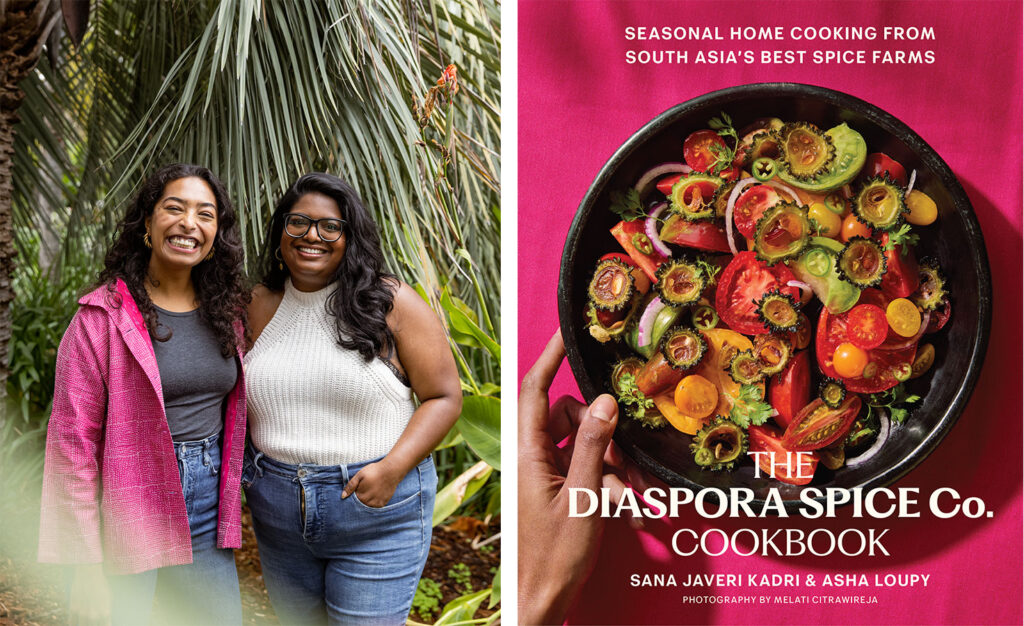
Sana Javeri Kadri and Asha Loupy. Photography by Melanti Citrawireja, used courtesy of Harvest books.
Your spice rack is filled with a long history. Not all of it good.
For centuries, spices have sparked exploration, fueled wars, and driven empires to colonize distant lands, all for a pinch of clove, nutmeg, or pepper. If that might seem extreme, just recall a dish perfumed with warm cinnamon, dry biting pepper, or the mysterious mingled tones of cardamom, and the desire to acquire might make sense.
Much of that imperial scramble converged on the Indian subcontinent, where spice, trade, and power were tightly entwined. But colonial rule left India’s spice farmers with little control over what they produced or how much they earned.
Some 400 years later, India-born Oaklander Sana Javeri Kadri looked around and decided that not much of what colonization had wrought for spice farmers had changed. They still earned little, and the slow journey of most spices and herbs to kitchen cupboards means that cooks experience little of the potential. Kadri wanted to try to rectify that.
So, in 2017, she founded Diaspora Spice Co. to source from small farmers in South Asia. The company’s mission is “to disrupt the industry with culture, equity, and joy.” From the start, the company’s guiding question has been: “Does our work perpetuate erasure of culture and cuisine, or does it hold the promise of undoing some of that harm?” She started the business with one spice: Pragati Turmeric from one family. Over time, offerings have expanded to 30 spices from more than 140 farms in India and Sri Lanka, with a focus on regenerative farms practicing sustainable and climate change–resistant agriculture.
Kadri now share the riches in The Diaspora Spice Co. Cookbook, published by Harvest books in March 2026. The vividly photographed volume with its striking hot-pink cover does more than present recipes. It introduces 85 herbs and spices she considers as culinary heirlooms, each rooted in the farms and regions the company has partnered with across India and Sri Lanka. Headnotes for each recipe move beyond instruction to situate the dish within a network of people, places, and practices, offering glimpses of the farmers, regional traditions, and agricultural realities that shape what ends up on our plates. For Kadri, the farmers aren’t just anonymous producers but collaborators, their knowledge, labor, and livelihoods inseparable from the spices themselves.
The book opens with five foundational spice blends: a roasted curry powder, a chili powder, a chili-coconut mix, a curry leaf blend, and an herb-laced salt. (Notably, there’s no garam masala.) Spice blends work particularly well because they layer flavors to build complexity and depth, each spice contributing its distinct notes of heat, sweetness, earthiness, or brightness that together convey what a single spice could not.
Anchoring such understanding of spices and the blends, the book opens into a wide, inviting range of inventive and memorable dishes. Consider the Doude Alle Dip, where sweet honeynut squash meets tangy labneh, together lifted by caraway, fennel, and a layered spice blend that brings a quietly complex finish. A Jammy Egg Curry from Kerala leans in the opposite direction—rich, savory, and deeply aromatic—with whole eggs nestled in a sauce built from coriander seeds, turmeric, black pepper, and Byadgi chili that adds color and gentle heat without overwhelming the dish. A real crowd-pleaser is the Turmeric-Banana Snacking Cake, its golden crumb infused with earthy turmeric and ripe banana, lightly spiced and fragrant with a tender, almost custardy softness that makes it difficult to stop at one slice.
This is truly a cookbook that serves conscience and deliciousness in equal measure.

Diaspora Co. spice farms. Map courtesy of Harvest