Cooking Up a Maker Community
Megan Bre Camp’s Summer Solace Tallow
By Cheryl Koehler | Photos by Jessa Carta
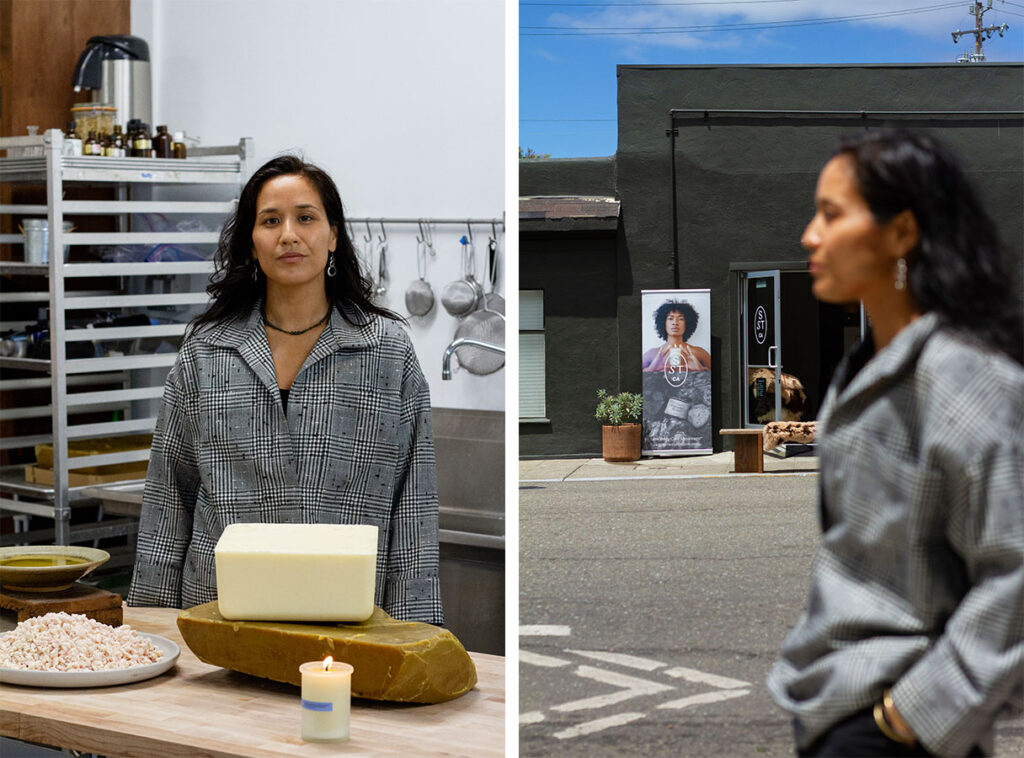
ON MOST ANY SUNDAY MORNING throughout the year, the Temescal Farmers’ Market in Oakland is a riot of geniality as neighbors amble in for coffee and pastries and kids splash in the rivulet that runs along the DMV parking lot. Rockridge resident Megan Bre Camp is always there among her neighbors. Under her Summer Solace market tent and in her shop across the street at 5303 Claremont Avenue, she brings together goods by various farmers and crafters who are part of her Summer Solace community. Her handmade tallow-based skin balms, soaps, face oils, candles, and perfumes are arrayed on one table under the market tent, and on another she curates a collection of kitchen provisions, functional medicines, and books, plus yarns, textiles, and naturally tanned local sheepskins from the Northern California Fibershed Cooperative.
“All of our core ingredients, except for certain essential oils, are sourced from within 150 miles of our Oakland studio. Every ingredient I work with carries a story that I can share. Each material reflects lineage and place,” Camp says.
“Our beeswax is sourced from my neighbor, a master beekeeper from Yemen,” she says, pointing down the row of tents to where Khaled Almaghafi sells his Bee Healthy Honey. “Our bladderwrack seaweed is hand-harvested off the Mendocino coast by my friend Julie Druckner. She sun dries each frond to preserve its minerals, salts, and nutrients.” The Séka Hills extra virgin olive oil is grown and milled in the Capay Valley by the Yocha Dehe Wintun Nation. These are relationships that Camp has nurtured since she started a culinary journey that veered onto a unique path.
A step back to the beginning takes us to Anchorage, Alaska, where Camp’s father, Pier Phinaih, raised his family. “He’s indigenous to the Central Highlands of Vietnam, from the Sedang tribe,” Camp says. “He was a Green Beret and translator for the United States during the Vietnam War. He raised me to be independent, to tend the land through organic gardening, and to be self-sufficient. We hiked, fished, camped, gardened, picked mushrooms and blueberries, and made ferments in the fall to prepare for winter.”
Camp’s mother, Carmen Romero, comes from a group of indigenous minorities in the Philippines. She came to live in San Francisco and conveyed her own cooking traditions and techniques to her daughter during Camp’s Bay Area visits. When time came for college, Camp went for a culinary arts degree, and she held onto her interests in holistic nutrition and traditional diets as she moved to Oakland in 2004.
“I began cooking in vegetarian restaurants,” she says as she describes her immersion into the culture at the Berkeley Farmers’ Market, the local Slow Food movement, and the region’s deep connection to local agriculture. She spent a summer in Maine working on a farm through the World Wide Opportunities on Organic Farms (WWOOF), where she met young farmers who prioritized the use of every part of each animal they raised and harvested.
“Across traditional cultures, animal foods, fats, and organs were valued for their nutrient-dense and medicinal properties,” she says. “I was a vegetarian at the time, but this experience opened my eyes to zero waste in relation to livestock.”
Back in the East Bay, she went to work at Berkeley’s Three Stone Hearth, where she mastered traditional food preparation methods including probiotic fermentation of krauts and sodas, soaking of grains to boost nutrient bioavailability, slow cooking of bones to render their minerals into broths, and the use of organ meats in savory dishes. “During this period, I shifted from vegetarianism to an ethical, local, and sustainable approach to eating, learning about urban farming and sourcing regenerative food before ‘regenerative’ was a buzzword,” she says.
Camp’s curiosity then led her to work with a French chocolate maker in Emeryville. “That work taught me patience, precision, and an understanding of how to gently render fats at low temperatures,” she says. Her latent interests in aromatherapy and scent blending blossomed as she realized that the skills involved in rendering fats for silky chocolate were applicable to making skin care products. “Animal fats are a powerful carrier oil, and any herb you infuse them with will be absorbed into the skin more readily.”
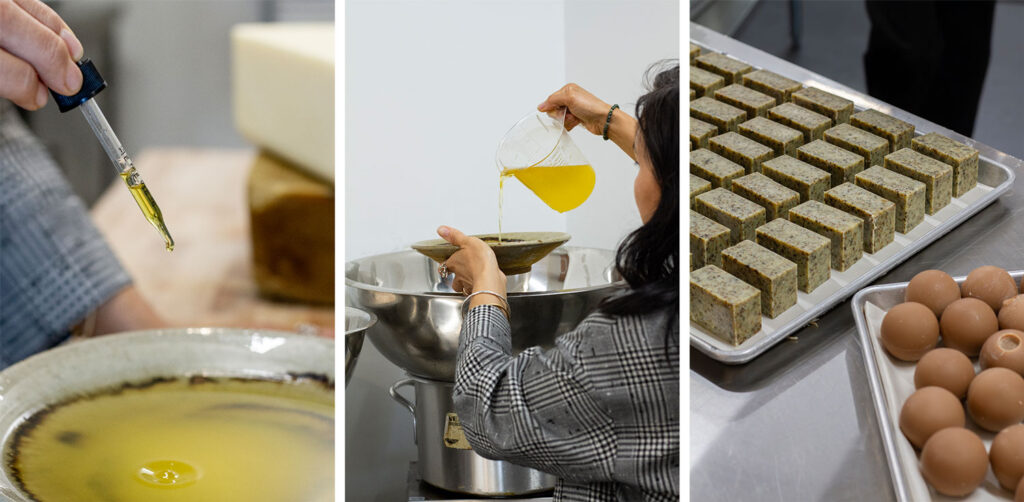
A mother with a tiny baby stops by the farmers’ market tent looking for a jar of the soothing tallow-based skin balm that Camp first formulated in 2014 when she founded Summer Solace. Creating the product was a way to help friends whose children were struggling with eczema and other skin irritations.
“Suet, the hard fat surrounding a ruminant animal’s kidneys, is the most nutrient-dense and highly prized source for tallow,” says Camp, who gets her suet from Stemple Creek Ranch, a regenerative farm in Petaluma.
Camp admits that in 2014, when plant-based eating was trending, she faced pushback from farmers’ market customers over the animal fat–based products, but she adds, “I welcomed those challenging moments as opportunities for education and inspiration. My work has always centered on sustainability, honoring the whole animal, reviving a traditional ingredient, and making it approachable and art-forward in the modern era.”
Back at the Temescal market, Camp exudes a deep calm and gratitude as she greets customers and other vendors. “My work is deeply relationship-based,” she says. “I live within the farmers’ market community that I source from and sell to. That reciprocity fills me with joy and inspiration. This is how I have built my legacy: through meaningful relationships with stewards of the land and sea.” ♦
Learn more about photographer Jessa Carta at jessacarta.com.