In Awe of an Apple
By Supriya Pandit
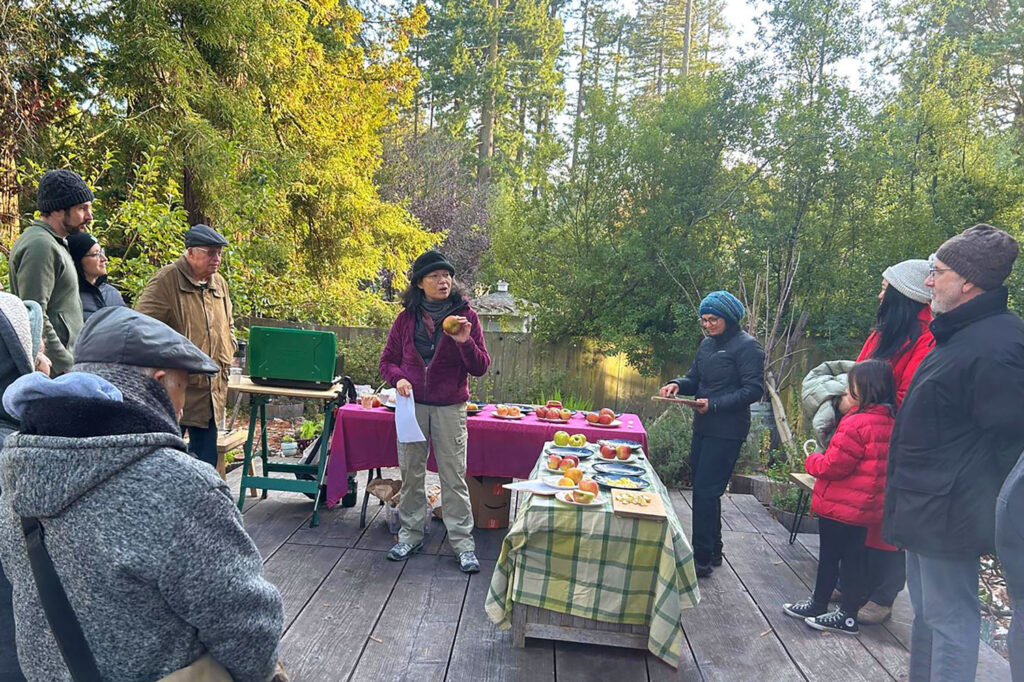
Sharon Zo (center) is pictured here speaking at the apple tasting she held for some neighbors on November 30, 2025.
It started in 2022. Pandemic rules were relaxing and socially starved neighbors were beginning to mingle. Our block in Kensington had a new neighbor in the house with the enviably large lawn backing into a redwood grove. Sharon Zo was teeming with enthusiasm for all things trees, soil, and ecosystem, and she surprised us with her acumen and generosity as she took on the neighborhood’s fruit tree–related questions. My 10-year-old apple trees were in dire need, and Sharon’s wingspan extended to accommodate them. We started calling her Dr. Sharon.
Getting to know Sharon Zo made me realize how ignorant I was of the broad and intense flavor profiles that fruit can express. With apples, for instance, my vocabulary was restricted to “sweet” and “crisp.” Dr. Sharon was about to teach me so much more.
Sharon Zo gained much of her expertise under horticulturist Orin Martin at the Center for Agroecology at UC Santa Cruz as she studied organic farming and agroecology with an emphasis on fruit trees. Her knowledge deepened as she volunteered in the extensive UCSC orchard and with rare fruit grower Freddy Menge at his orchard in Watsonville. Through it all, she evolved her discerning palate through curiosity and experimentation. “I love pomelos, but the pomelos from the store are really dry,” she said. “My dad had told me if you let them sit until the skin shrivels and gets wrinkly, the fruit tastes much better.”
During the late summer and fall apple harvest, Berkeley’s Monterey Market stocks dozens of varieties, and Dr. Sharon wants to taste them all. “I started looking at each fruit as I picked it out, relating certain visual characteristics with taste,” she said.
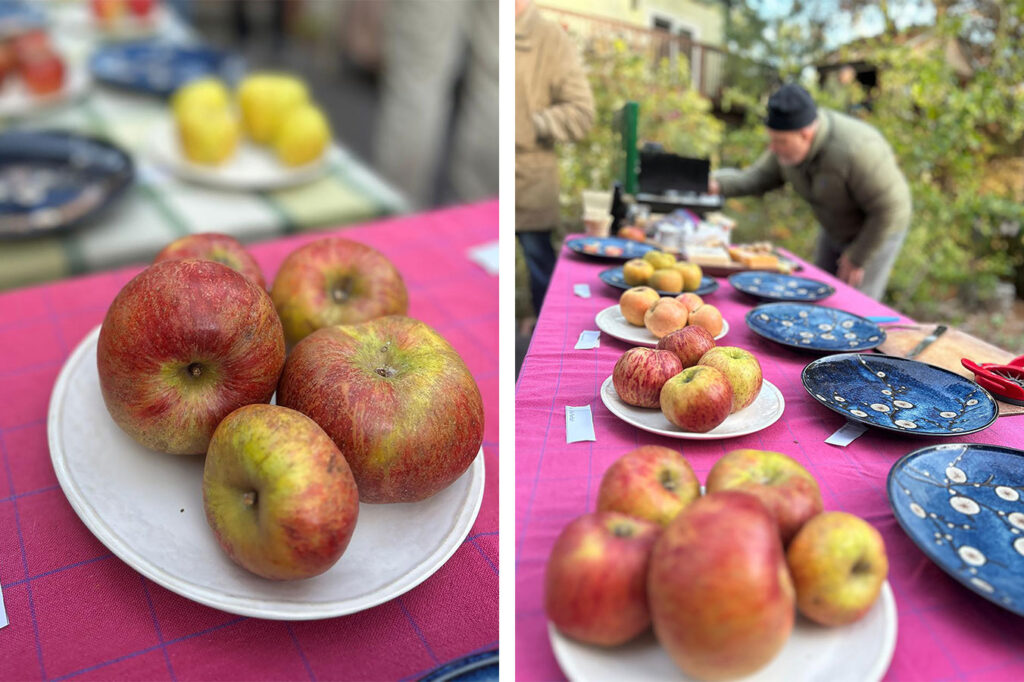
Apple tasting
During the time she was studying at College of Marin, she noticed that some peaches and nectarines had freckles, and the more the fruit had, the better it tasted. “My teacher, John Valenzuela, confirmed that the freckles on the peach are sugar spots, but the freckles are sadly considered a defect by the fruit industry,” she said.
Sharon’s interest led her to the California Rare Fruit Growers (CRFG), and she became a regular at their apple tastings in Santa Cruz. “Suddenly, instead of knowing 10 varieties, I knew 40 to 50 varieties,” she said.
The people in her network of growers introduced many apple varieties that commercial growers ignore, and Dr. Sharon began sharing her findings with our group of neighbors. My first bite of a crab apple named Transcendent came as a shock. Could there really be so much flavor in such a tiny fruit?
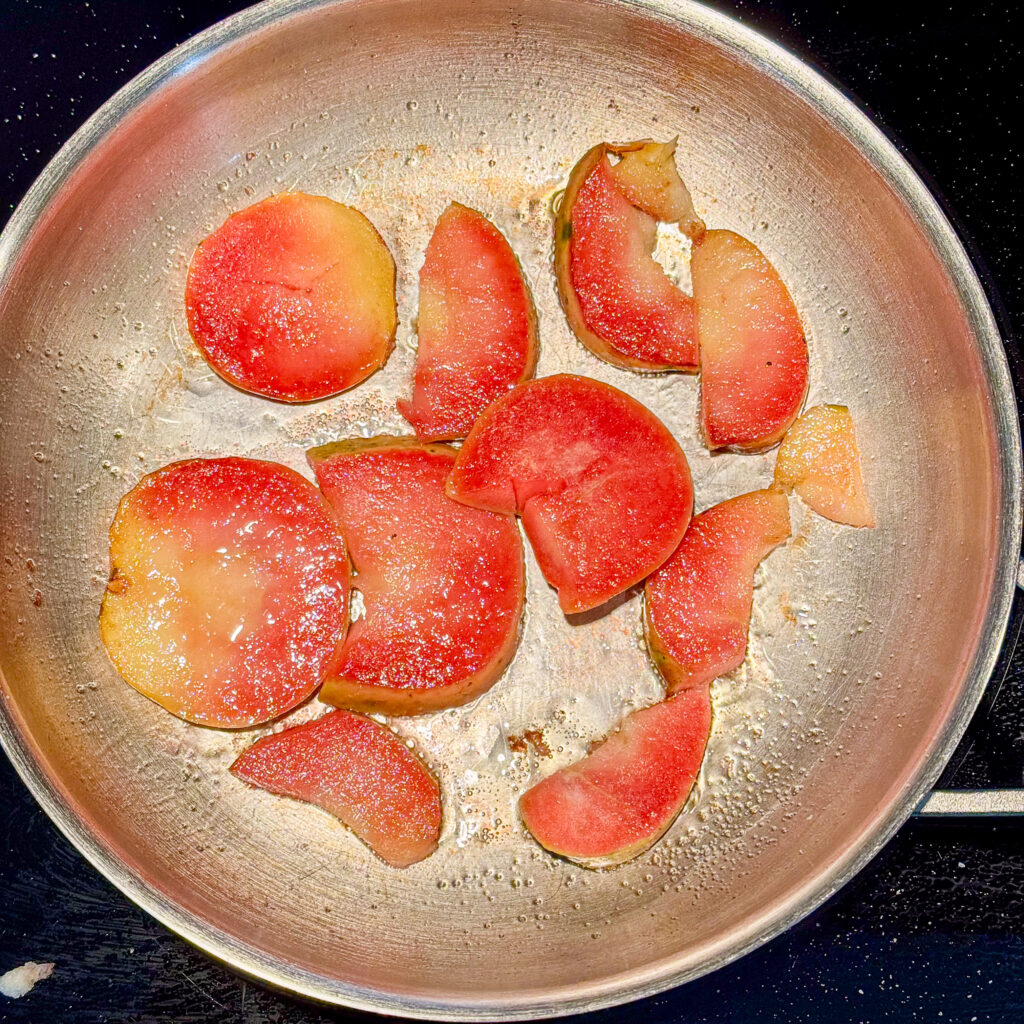
Marc Mosko set up a camp stove and sautéed slices of Pink Parfait apples so the group could discover the wonderful flavor of the hot apple slices cooked with nothing more than a little olive oil and salt.
Sharon began showing us the value of these apples in the kitchen. A boxful of blemished apples from Freddy Menge’s Westside Santa Cruz Farmers’ Market stand were turned into a rich, ruby-red apple sauce. Some grounders collected from Chadwick Garden in Santa Cruz also became a delicious sauce, and that’s when I became acquainted with an heirloom called Belle de Boskoop. When Sharon brought bags of Bramley’s Seedling apples from Garin Regional Park’s orchard of heirlooms in Hayward, we promptly converted some into apple chutney. Some Golden Russets, as I learned, needed nothing but a pinch of salt and cinnamon to become a sauce that could rival any fall fruit dessert. It dawned on me that my knowledge of flavor, texture, shape, and form had been limited by my previously myopic lens on what was “good fruit.” Sharon credits Michael Pollan’s The Botany of Desire for awakening her understanding of why yesteryear’s varieties are far more intensely flavored than the big red and shiny apples we have become conditioned to buy.
“Good eating apples, some heirloom varieties that ripen over a period of four weeks, are often limited to farmers’ markets or specialty food stalls,” she explained. “Before the arrival of reliable refrigeration, produce was grown and sold locally.” The disappearance of those old apple varieties started in the 1930s with the industrialization of agriculture. “Processors and distributors wanted fruit that could be harvested under-ripe and survive storage for up to a year, making global shipping possible.” It’s why Sebastopol’s Gravenstein, which doesn’t last for more than two weeks, is considered fragile and commercially unviable.
With Dr. Sharon’s help, my apple trees were grafted with scions of new varieties. We fed the trees with organic matter and pruned them to improve aeration and access to sunlight. “A tree growing with organic matter uses chlorophyll to make carbohydrates, and carbohydrates are like money for the tree,” Sharon explained. The bacteria and fungus in the soil cannot make carbohydrates even though it’s critical for their function, so in a clever trade, the fungal organisms reach great distances with their mycelium to break down rocks into minerals and offer them back to the trees. Interestingly, these tiny amounts make a significant difference to the quality and taste of the fruit.
Sharon Zo is a born teacher. When she set up small backyard tastings with her haul of unique apples, she called on us to taste, smell, look, and feel. We ate our way up the table from mellow to sharp while she regaled us with morsels of apple history, geography, and economics.
During one of the tastings, Sharon pointed out an apple with yellow-green skin and soft reddish-orange freckles. Had Claude Monet depicted that apple in a painting? Sure enough, the lumpy Calville Blanc d’Hiver I was holding is a variety that Monet is known to have depicted in several still life paintings. On that crisp fall evening, I had the surreal, almost holy feeling that the artist had reached across 150 years and was sharing in our awe of an apple. ♦
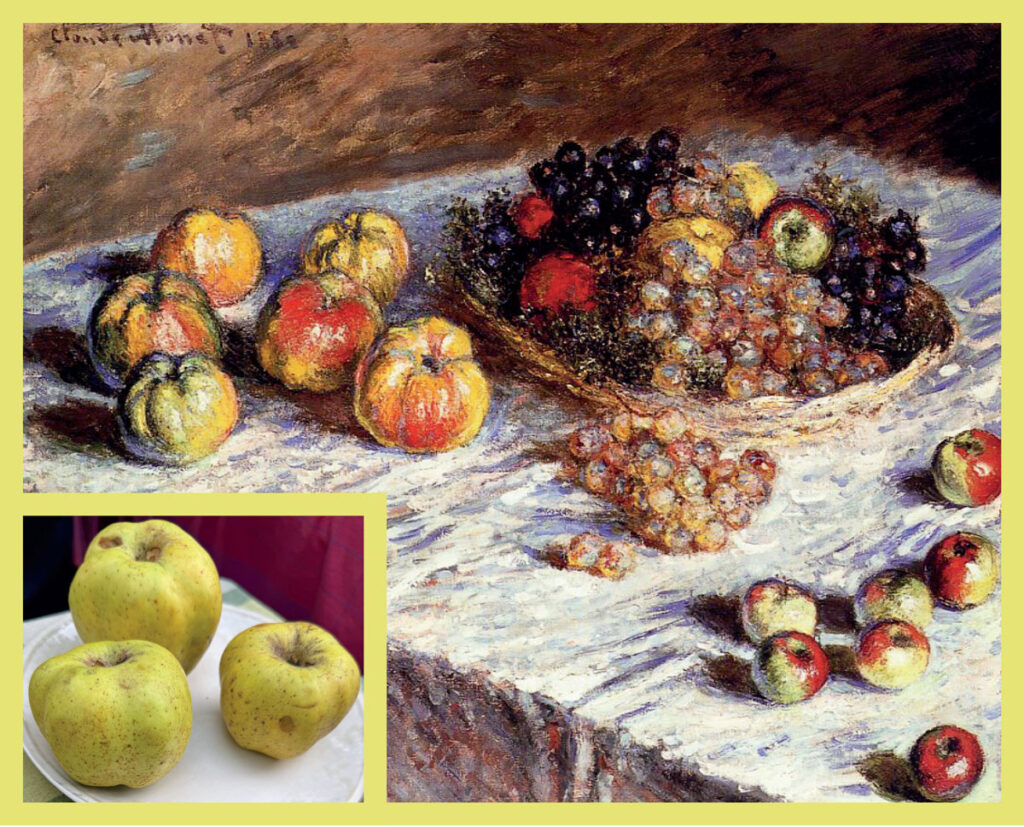
French oil painter Claude Monet (1840–1926) used the title Still Life with Apples and Grapes for several similar works. All included the bumpy apple named Calville Blanc d’Hiver, which made an appearance at Sharon Zo’s November 30, 2025, tasting. The apple won points for looks but lost to Hauer Gold and VIP for flavor. (Art Institute of Chicago, public domain image)
Sharon Zo’s Advice and Resources for Home Gardeners
If you are looking to plant an apple tree on your East Bay property, Sharon Zo recommends a russet called Hudson’s Golden Gem. “It is a very aromatic apple. Not too sour with a wonderful taste.” Other good choices include two McIntosh descendants, Empire and Macoun, the intensely flavored Newtown Pippin (the apple that the Martinelli company first used to build their sparkling cider empire), and Wickson, a small, sweet, red crab apple good for eating and cider. Grenadine, Rubaiyat, Strawberry Parfait, and the more commonly available Pink Pearl are some of the red, pink, dark pink, and marbled apples that Sharon recommends. In addition to their intense, berry-like flavors, they offer a delectable visual experience and are good for applesauce. Backyard growers with more experience might try Cox’s Orange Pippin, Karmijn de Sonnaville, and Suntan, which do better with cooler summer temperatures.
To find what works for your specific garden, Sharon’s advice is to take small steps: “Join an organization, find a recommendation for a tree, plant it, observe it, and see how it goes.” Apple tasting is an excellent way to explore a variety you might like.
In October, Sharon will be present at the California Rare Fruit Growers (CRFG) Monterey Bay chapter’s annual apple tasting at the Heritage Harvest festival located at Wilder Ranch State Park. If you would like to be alerted to this and other upcoming tastings and workshops with Sharon Zo, subscribe to Edible East Bay’s e-newsletter. Find the sign-up form at eepurl.com/z-fkn(opens in new tab).
Dave Wilson Nursery, probably the largest wholesale nursery in California, has a very informative website: davewilson.com(opens in new tab).
Near San Luis Obispo, Trees of Antiquity sells organically grown trees to both home gardeners and commercial growers. Fall is the best time to order trees. treesofantiquity.com(opens in new tab)
Berkeley Horticultural Nursery has a good selection of high-quality bare-root fruit trees from late January through early March. Bare-root planting generally produces the healthiest trees. berkeleyhort.com(opens in new tab)
The Ark of Taste, a catalogue of endangered or historically significant foods maintained by Slow Food USA, has many hard-to-find heirloom apple varieties including these that do well in California: Arkansas Black, Gravenstein, Roxbury Russet, Esopus Spitzenburg, and Sierra Beauty. slowfoodusa.org/ark-of-taste
The book titled Fruit Trees for Every Garden, by Sharon Zo’s mentor Orin Martin, will tell you how to plant your first tree and what you need to do with the tree once you plant it.
Visit grower Freddy Menge at his Epicenter Orchard booth at the Santa Cruz Westside Farmers’ Market to buy rare apples like those enjoyed at the November 30, 2025, tasting. epicenteravocados.com/apples(opens in new tab)
The California Rare Fruit Growers Golden Gate chapter annual Scion Exchange in February at Diablo Valley College in Pleasant Hill will be a good opportunity to obtain scions and rootstocks of special varieties at a small cost.
The annual Garin Apple Festival at Garin Regional Park in Hayward takes place this year on Sunday, September 6. This popular family event with cider pressing and other children’s activities features tastings of apples from the park’s historic orchard where there are over 150 distinct varieties like Red Baron, Emma’s Apple, King David, Hudson’s Golden Gem, and Etter’s Gold. ebparks.org/parks/garin(opens in new tab)
Sharon Zo has been teaching grafting workshops and hosting heirloom apple tasting events since 2020. Last fall she hosted a tasting with Hudson’s Golden Gem, Golden Russet, Ashmead’s Kernel, Cox’s Orange Pippin, Newtown Pippin, and Wickson Crab. Participants ranked the apples and we had a few winners. The lawn in Sharon’s backyard is now replaced with a small urban farm where she grows some of her favorite hard-to-find varieties of fruit. She hopes to share fruits from her own orchard during future tastings and workshops.
When she’s not thinking up new recipes in her Kensington kitchen, longtime Edible East Bay reader Supriya Pandit creates in film, technology, and poetry. You can find her at supriyapandit.com.
Thank you to several participants at Sharon Zo’s November 30, 2025, apple tasting for the photos included in this story.