Placemaking in El Sobrante
An inspired team creates a vibrant new ‘third place’
Story and photos by Clara Rice
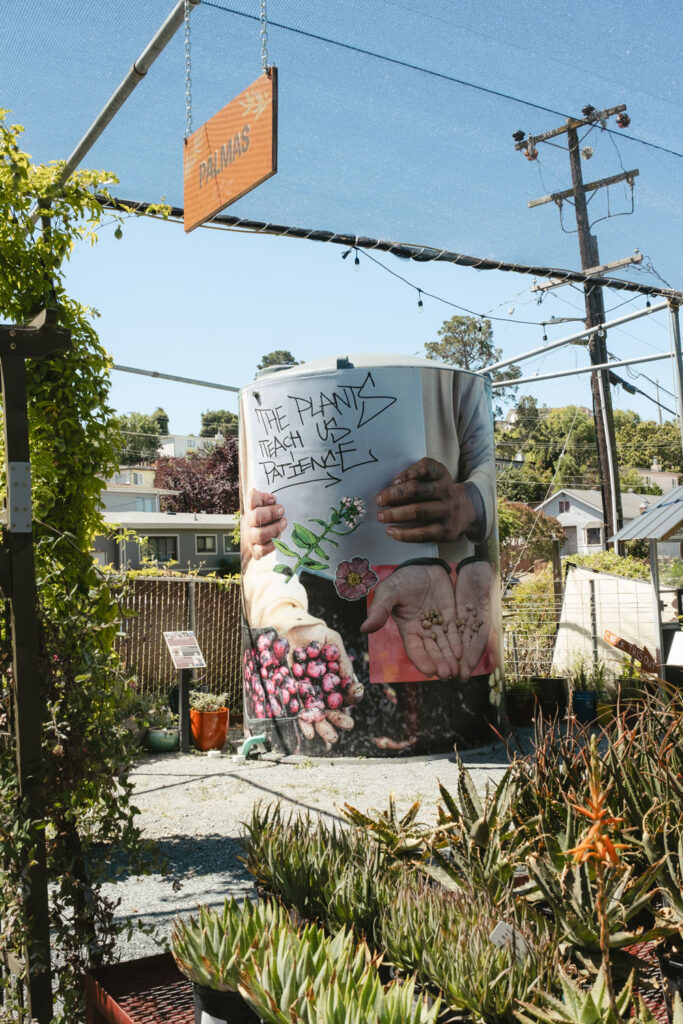
Nine years ago, the beginnings of a dream formed in a simple shared thought: El Sobrante does not need yet another gas station.
With a name that translates literally as “the leftover,” El Sobrante is an unincorporated section of West Contra Costa County that abuts the seemingly haphazard borders of Richmond, San Pablo, Pinole, and Orinda. Partly suburban, partly rural, it’s a place where it’s not uncommon to see someone riding a horse down the street, pointedly bypassing the 13 gas stations.
The center of town is a strip along San Pablo Dam Road, but this story takes place about a mile away at the intersection of Sobrante Avenue and Valley View Road on the former site of Adachi Nursery, a family-run business that closed its doors in 2017, leaving the property open to the whims of developers. Reinventing the use for these acres has been a circuitous but ultimately inspiring journey as many individuals and organizations joined forces to create a new social hub.
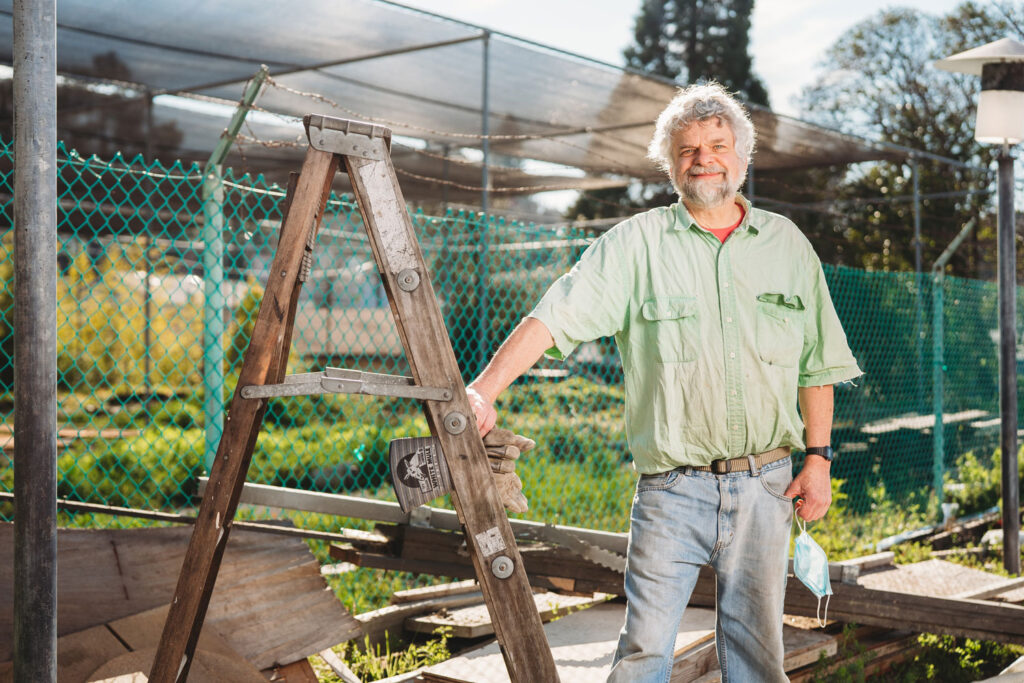
Serge Glushkoff is the founder of Triangle Works, the nonprofit host of The Shed.
One of the key players in this unique land use turnover is Serge Glushkoff, a recently retired environmental scientist who has lived in El Sobrante for 25 years. He is the founder of Triangle Works, a nonprofit that aims to revitalize this triangle-shaped property. Like many, he landed in El Sobrante accidentally. “A lot of people here are former Berkeley or Oakland people,” Glushkoff says. “They had kids, Berkeley stopped being affordable or desirable, and they ended up here. Nobody says, ‘I’m moving to El Sobrante.’”
It took nine years from Adachi’s closure, infinite meetings, a developer negotiation, local politics, a petition or two, thousands of volunteer hours, and an unlikely partnership between nonprofits before the community arrived at today’s odd but successful combination of establishments. Glushkoff worked alongside many others—the founders of Planting Justice and The Good Table plus local politicians and many motivated community members—to realize the dream of this reinvention.
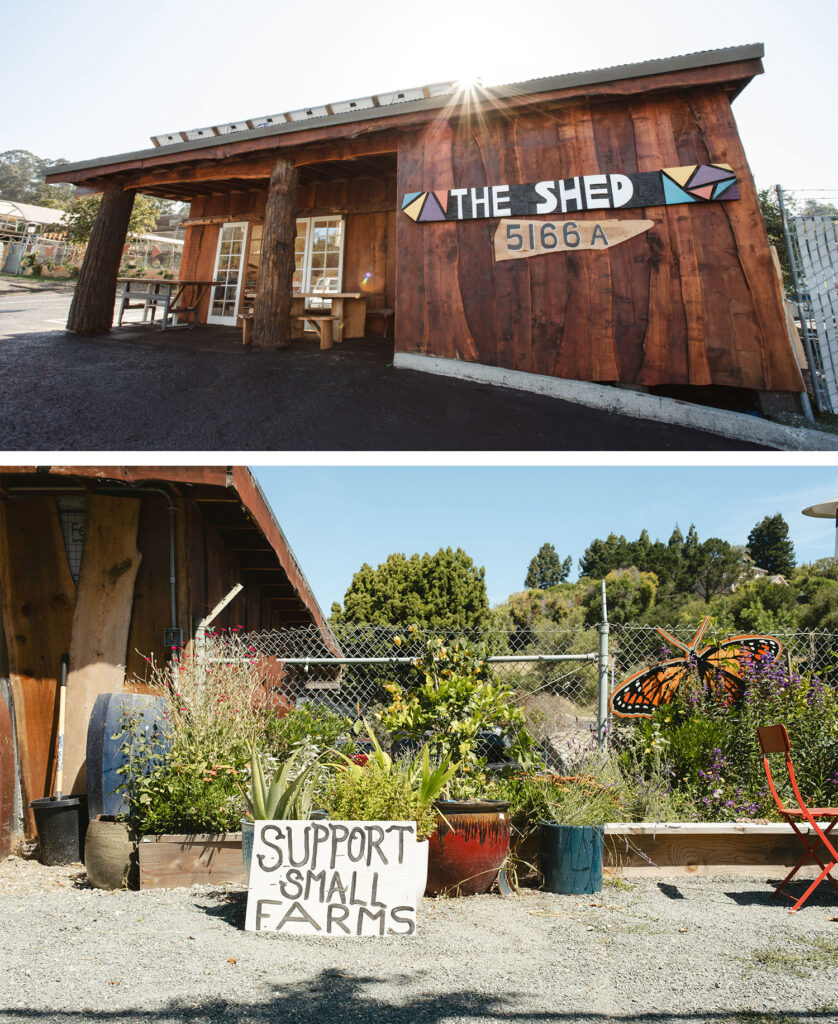
Three ventures share the triangle-shaped property. First is The Shed. This project of Triangle Works serves as a makers’ marketplace and class space that gives a platform to local artisans while creating a venue for imagination and community. Second is The Good Table Cafe, where a break for coffee and a bite to eat is likely to include an encounter with someone you know. It also serves as a church and meeting space that welcomes all. The Good Table hosts a shop for locally made crafts and gifts.
The third of the three ventures is the Planting Justice Nursery and Farm Store, a social enterprise that beautifully carries forward the site’s nursery legacy. Founded 18 years ago, Planting Justice continues under cofounder Gavin Raders with its mission of creating full-time living-wage jobs for people with barriers to employment: formerly incarcerated, recent immigrants, and others. The nonprofit’s current iteration employs 50 people across multiple sites. Employees propagate 1,600 varieties of hard-to-find plants while receiving hands-on education in horticulture and business operations.
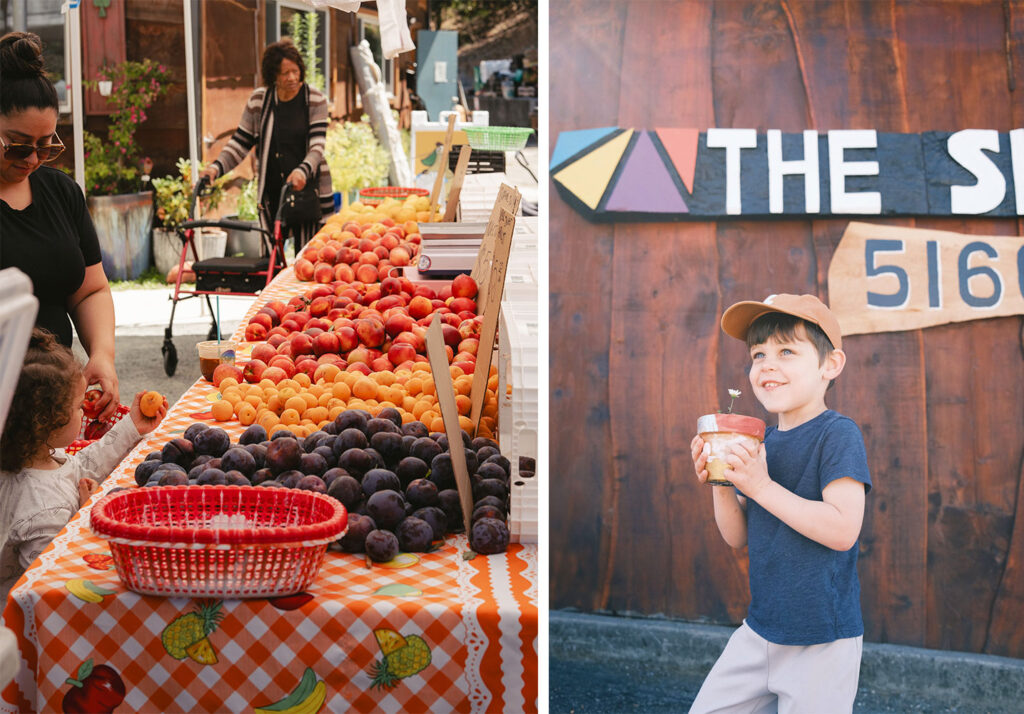
Left: The Planting Justice farmers’ market is a true neighborhood gathering place.
Right: Leo Zak, a local regular, with a pot he painted at The Shed
Beyond these day-to-day offerings, Planting Justice offers a Sunday farmers’ market that is a true neighborhood gathering place. The small-but-mighty group of participants that filter in and out from week to week are assessed no stall fees, and the organization buys any unsold produce, thereby guaranteeing a sellout for vendors. Planting Justice sells the surplus on a sliding scale from their mobile farmers’ market truck, which seeks to reach underserved communities between Richmond and Oakland. The remainder of the produce is turned into jams, pickles, and other value-added products that are sold in the farm store.
On farmers’ market Sundays, The Good Table acts as an adjacent center of gravity; a DJ spins vinyl in the Planting Justice yard as kids pull wagons through the rows of available plants, and The Shed staff set up an art table where kids can learn and create something unique. If you’re local, there is absolutely no chance of coming by on a Sunday and not running into a neighbor or friend.
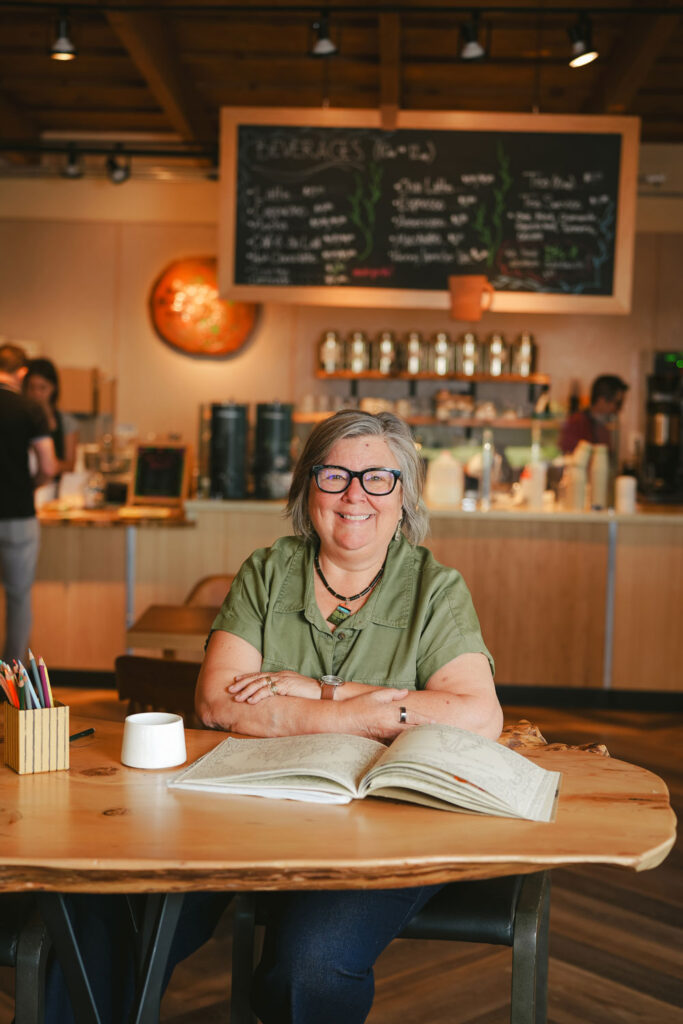
Melinda McLain founded and serves as pastor at The Good Table.
There is a single word—community—that repeatedly emerges in conversations with Raders, Glushkoff, and Melinda McLain, the founder and pastor at The Good Table. In fact, it might be the only word that really matters.
“What I cared about was placemaking,” says Glushkoff, “this idea from human geography about creating a sense of place.” A scattered, liminal, unincorporated town like El Sobrante benefits strongly from the relationships built within its borders, between its neighbors. “Part of building community is creating psychological or spiritual resilience,” Glushkoff adds. McLain independently echoes this sentiment. “Third spaces prevent silos, and the silos we live in are absolutely going to kill us all.”
“We want people to start imagining the kind of world that we all want, that we deserve,” says Raders. “Talking with our neighbors. All the ripple effects that we’ll never see.” In McLain’s words, “You create a container where people can do their own work.”
Every food item sold at The Good Table originates from within ten miles of the café, a feat that is harder to pull off than it sounds. Pastries come from local bakers as well as Acme Bread. The soup comes from someone who I only know as Fairy Mary. “All of our employees can walk or bike to work except one,” McLain shares. “We’re hyperlocal in every sense.”
That one employee, café manager Chivi Marincola, commutes from Berkeley, and has become essential to The Good Table after only a few months. Unlike the others I talked with, Marincola was not part of the backstory; she gets to experience the realized version. With a 20-year background in permaculture and baking on a farm in Brazil, she came to The Good Table after a few years of burning out in the high-stress commercial baking industry.
“I founded several farmers’ markets in Brazil,” Marincola says, “[but this is] the first time I feel that all of my qualifications are actually put to use. And they’re valued. So that makes it even more exciting for me. They basically just handed me the café and said, ‘Do whatever you want.’”
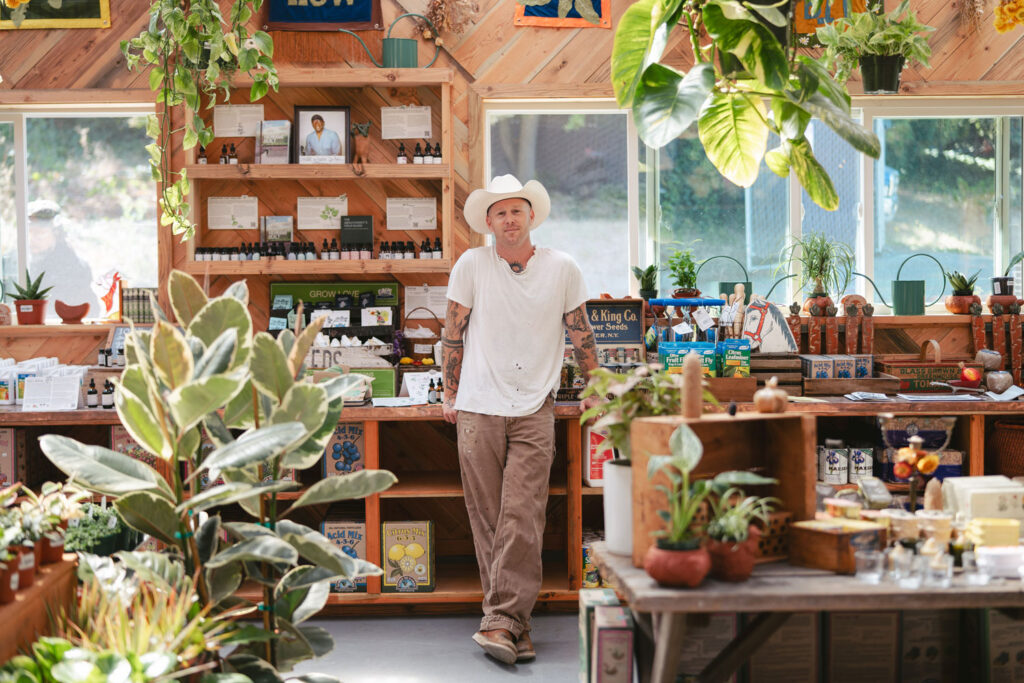
Sam Lustig runs the El Sobrante arm of Planting Justice.
Sam Lustig, who runs this local outpost of Planting Justice as well as the farmers’ market, comes from 15 years running the farm store and commercial kitchen at Swanton Berry Farm in Davenport, California, the first unionized and certified organic strawberry farm in the United States. Lustig’s handmade strawberry jam is worth the trip alone, and he recently added pickles to his offerings of value-added foods made from local produce. Slices of fresh-made pies and blueberry scones line up in the shop alongside rakes, seeds, candles, and a newsstand of antiestablishment zines. A drop-in workshop offers the opportunity to create and then burn effigies. Across the yard, kids pick and munch on mulberries from unsold trees.
In talking to Raders, I have learned that each space here has multiple purposes, and each purpose has a lengthy and worthy backstory. When asked if he has come up with a more succinct summary of the three spaces, he says, “There isn’t a really great way so far, but I think that’s okay. If people want to hang out there for a couple of sentences and hear what it is, I’m like, yeah. Lean into that.” ♦
Find The Good Table Cafe, Planting Justice Nursery and Farm Store, and The Shed at 5166 Sobrante Ave, El Sobrante. triangleworks.org; the-good-table.org; plantingjustice.org; theshedelsobrante.org
Clara Rice is an East Bay–based commercial, editorial, and portrait photographer. Her work spans from restaurants to tech to brand advertising, with the occasional writing stint thrown in as well. Follow her on Instagram @clara.rice.photo and see more of her work at clararice.com.