Preserving Ukraine
Story and recipes by Anna Voloshyna

Anna Voloshyna (Photo by Jason Perry)
One of my first kitchen memories is massaging salt into shredded cabbage. I couldn’t have been more than five or six, standing on a wooden stool in my grandmother Olia’s kitchen in Southern Ukraine, my fingers turning red and a little numb from the cold, briny press of it. Grandma would shred a head of white cabbage as big as a watermelon, scatter coarse salt across the top, and tell me to squeeze. Push, Anyusha, push. You had to wait for the cabbage to give up its water, and only then could you pack it into a huge glass jar with a tight rubber lid and trust the autumn to do the rest. That jar sat in the corner of the kitchen for a week or so. Then it moved down to the cold root cellar, where it fed us, sour and crunchy and golden with a touch of carrot, all the way through winter and into March. This was preserving, but we didn’t call it that; we just called it preparing for winter.
In Ukraine, preparing for winter was not a hobby or a weekend project. It was a season of its own, somewhere between late August and early November, and every household took part. Tomatoes went into jars. Plums turned into jam. Beets and apples went into wooden boxes in the root cellar. Mushrooms came back from the forest in baskets and left the kitchen pickled, dried, or salted, depending on their kind. My mother lined up glass jars on the shelves the way some people line up books: by shape, by size, by usefulness. By February, when the snow outside had turned the gray of old aluminum, opening one of those jars felt a little like stepping back into summer.
Preserving. I’ve been thinking about that word a lot lately. I moved to California 15 years ago, and for months, I struggled to find produce that felt familiar. Then I discovered the farmers’ market. It was the first place where I connected to local food: the sheer abundance of it, tables overflowing with tomatoes, corn, peppers, melons, and herbs. During my first August here, I stood at a melon stand and got unexpectedly teary because the smell was exactly like Olia’s garden, half a world and a lifetime away.
What I’ve come to love about California is that the seasons here are gentler than the ones I grew up with. They are softer and far less brutal, but they are still seasons marked by produce. Stone fruit only lasts so long. Cherries have their brief golden weeks. Tomatoes have their moment, and then they’re gone for the year. The only way to keep them is to keep them: can them, ferment them, pickle them, tuck them into a jar with a little vinegar and a sprig of dill, and shut the lid tight. This is where the two meanings of the word begin to fold into one another. Because when I make a jar of sauerkraut, just like my grandma taught me, with little more than cabbage, salt, and time, I am not only preserving food. I am preserving my grandmother Olia’s wisdom and memories. I am preserving the traditions of a kitchen that the Russian Empire and the Soviets tried to erase, and that a war is trying to erase again right now. I am preserving a way of moving through the year: paying attention to what the land offers, taking only what I need, finishing one jar before opening the next. Slow food turns out to be slow culture, too. I’m not sure you can really hold onto one without the other.
So, most weekends now, you’ll find me at a market with a canvas bag that’s too heavy for my shoulder. I buy cucumbers and salt them. I buy peppers and turn them into spreads. I buy beets and ferment them into kvass. I buy late-summer tomatoes by the half-flat and put them up in jars that, six months later, will brighten a January afternoon. It all feels familiar. I’m doing what my mother did, what Grandma Olia did before her, and what people all over the world have always done, long before the word sustainability came along to make us feel modern about it. To preserve food is, at its heart, to refuse to waste it. And to refuse to waste it is to live a little more in step with the season, the soil, and the hands that grew it.
On the next page are two recipes I make every fall. The first, sauerkraut with fennel seeds and cranberries, is from my new cookbook, Ukraïne. The starter jar lives in my fridge from October through April. The second, kapusniak, is the sour cabbage soup that exists, in some form, in nearly every Ukrainian kitchen, and one of the best uses for the kraut you’ve put up. Make the sauerkraut first. Make the soup a few weeks later, once the jar is ready. Eat them together on the kind of evening when you need the inside of the house to feel brighter than the world outside the window. That, in the end, is what preserving is for. ♦
Anna Voloshyna is a chef, food stylist, and writer who was born and raised in Southern Ukraine and later immigrated to Oakland with her husband. She teaches cooking classes in the Bay Area and hosts pop-up dinners focusing on Ukrainian food. Her first cookbook, Budmo!, featuring family recipes, was published in 2022.
Sauerkraut with Fennel Seeds and Cranberries
Recipes and photos by Anna Voloshyna
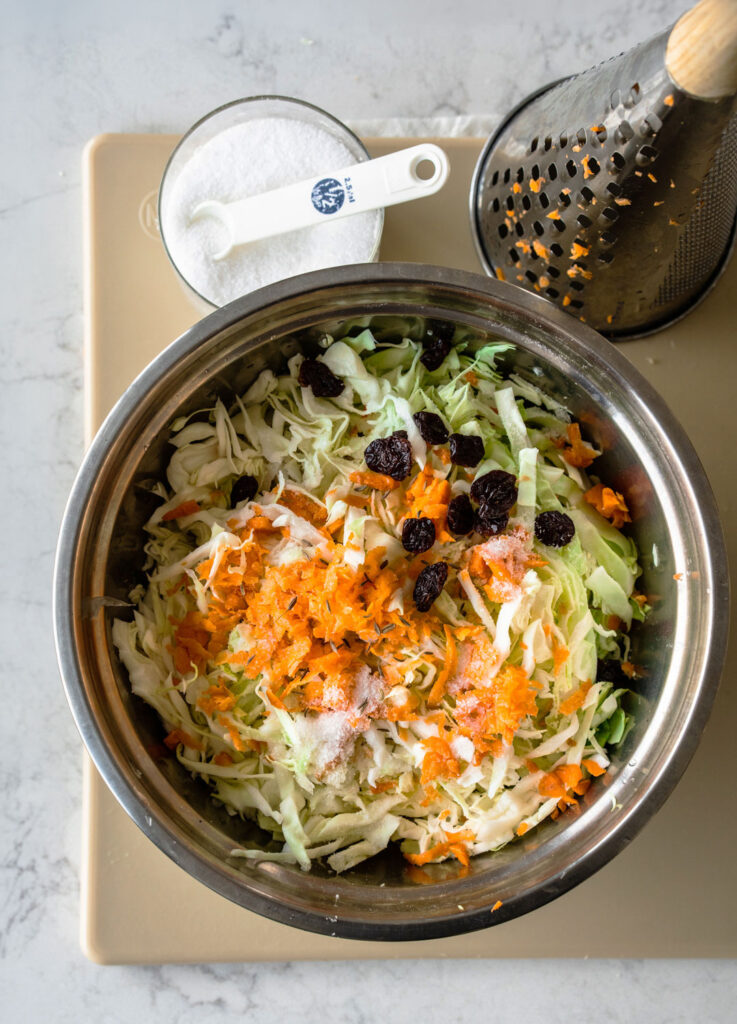 Makes about 1 (1-quart) jar
- 1 head green cabbage (about 1½ pounds)
- 1 tablespoon plus 2 teaspoons kosher salt
- 1 teaspoon fennel seeds
- 1 tablespoon dried cranberries
- 1 teaspoon honey
Remove a few outer leaves from the cabbage, rinse them well, and pat them dry with a paper towel. Set the leaves aside for later use. Using a small, sharp knife, cut out and discard the core of the cabbage. Then, using a large knife, cut the cabbage in half lengthwise. Using the large knife or a mandoline, cut each half crosswise into thin, uniform strips.
Transfer the sliced cabbage to a large bowl and sprinkle with the salt. Using your hands, massage the cabbage until it releases a substantial amount of liquid, 5 to 7 minutes. Add the fennel seeds, cranberries, and honey and mix well.
Tightly pack the cabbage mixture into a large wide-mouthed glass jar. Pour any remaining liquid from the bowl over the top to ensure the cabbage is submerged, then press down firmly with your fist. Place the whole cabbage leaves you set aside earlier on top, then add a heavy object—such as a jar filled with salt or water—to keep the cabbage fully submerged. Cover the jar with a plastic lid (see Note).
Let the cabbage ferment in a cool dark place (ideally 60°F to 65°F) for about 1 week. Begin tasting on day 4 and keep tasting until it reaches your desired level of tanginess.
Once the sauerkraut tastes good to you, remove the weight, cover the jar with a lid, and refrigerate it, where it will keep for up to 6 months. Always use clean utensils when removing the sauerkraut from the jar, and make sure the sauerkraut is always submerged in its brine.
Note: A jar with a plastic lid is easy to source online. A metal lid will rust.
Kapusniak | Sour Cabbage Soup
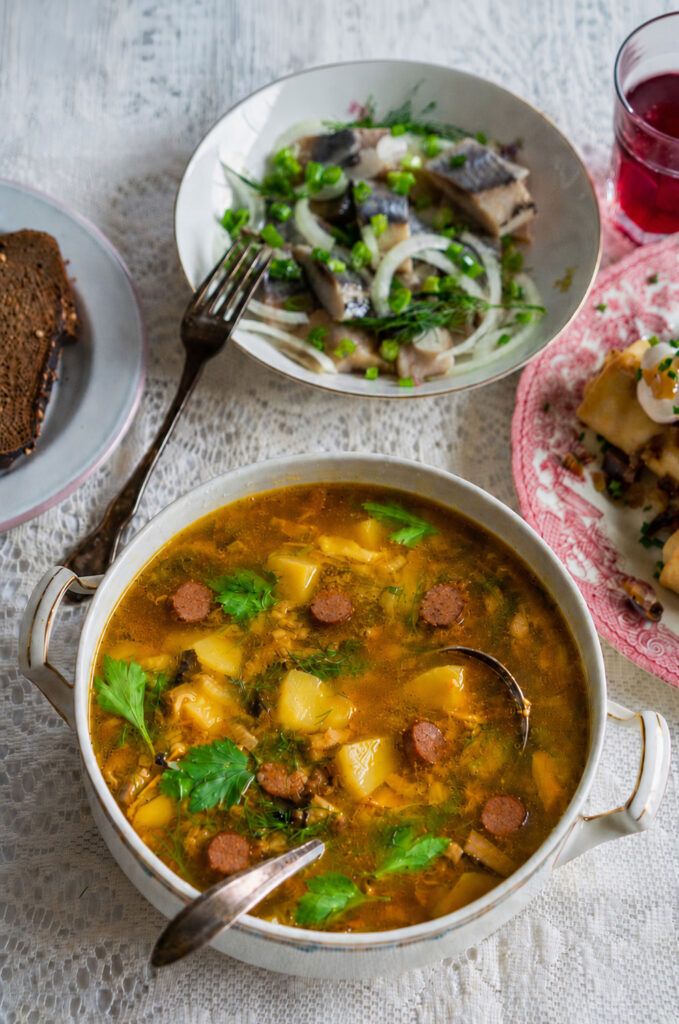 Serves 6
- 2 strips bacon, diced
- ½ pound smoked kielbasa, sliced into ¼-inch rounds
- 1 tablespoon sunflower or vegetable oil, if needed
- 1 yellow onion, finely diced
- 1 large carrot, diced
- 1 small parsnip, diced
- 2 garlic cloves, minced
- 2 quarts chicken broth
- 2 medium Yukon Gold potatoes, peeled and diced
- 1½ cups sauerkraut, with a little of its brine
- ½ cup millet
- 1 teaspoon sweet paprika
- 1 bay leaf
- Salt and black pepper, to taste
- Sour cream, fresh dill, and dark rye bread, to serve
In a heavy soup pot, cook the bacon over medium heat until it renders its fat and begins to crisp, about 5 minutes. Add the kielbasa and cook until lightly browned on both sides, about 3 minutes. Using a slotted spoon, transfer the kielbasa to a plate and set aside.
If the pot seems dry, add a splash of oil. Add the onion, carrot, and parsnip and cook, stirring occasionally, until softened and beginning to caramelize, about 8 minutes. Stir in the garlic and cook for another minute.
Add the broth, potatoes, sauerkraut, millet, and a splash of sauerkraut brine, paprika, and bay leaf. Bring to a gentle simmer, then lower the heat and cook, partially covered, for about 35 to 40 minutes, until the potatoes are tender and the flavors have melded.
Return the kielbasa to the pot and simmer for another 5 minutes to warm through. Discard the bay leaf.
Taste and adjust. Kapusniak should be pleasantly sour, lightly smoky, and just salty enough to make you reach for another spoonful. If it needs brightness, add a little more brine from the jar. If it needs body, mash a few of the potatoes against the side of the pot.
Ladle into deep bowls, top with a generous spoonful of sour cream and a handful of fresh dill. Serve with dark rye bread.