Keeping the Magic at Berkeley’s Three Stone Hearth
By Rachel Trachten | Photos by Mary Dee
Reflections on the early days of Three Stone Hearth (TSH), Berkeley’s one-of-a-kind cooperative kitchen and retail food store, often include a reference to magic. Perhaps that’s not so surprising when you consider how five community members created a thriving business based on nutrient-dense local foods, minimal waste, and shared ownership and governance.
Since its launch in 2006, TSH has developed a loyal following for its handcrafted bone broth, pickled veggies, probiotic sodas, krauts, stews, and soups, all made from nutrient-rich, mostly organic ingredients from local farms. Meats, eggs, and dairy products are from grass-fed or pasture-raised animals, and TSH favors traditional food preparation methods like fermentation, sprouting, soaking, and grinding. A new menu of fresh and frozen items is offered each week. Most food is packaged in glass Mason jars, which are returned by customers to be sterilized and reused, one of many labor-intensive feats that TSH workers pull off each week.
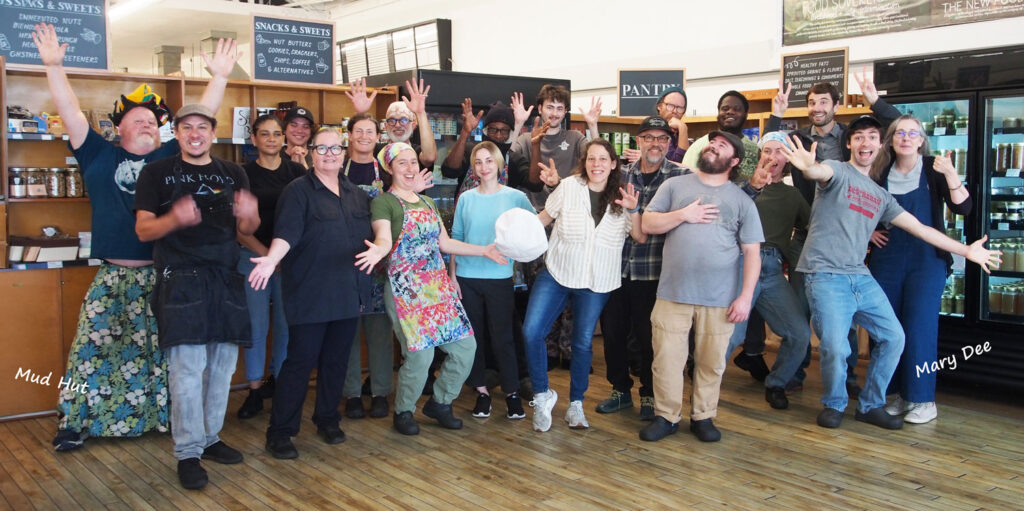
Worker-owner Mud Hut came to TSH as a volunteer in 2007, took a job there four years later, and then became a worker-owner. Now that the original five founders have moved on, Mud Hut and worker-owner Mary Dee, who started part-time in 2007, have the longest history at TSH and a unique perspective on its 20-year evolution. Those years brought tremendous growth in the amount of food made in-house as well as in retail items sold. During the Covid pandemic, TSH faced a temporary shutdown, a loss of personnel, and a pause in cooking workshops and demos. Today, some of these in-person events have returned, and the mood is one of optimism balanced with practicality.
“Earlier on there was a feeling that things were mostly propelled by a magical force that we all drew from and contributed to,” says Mud Hut. “And while I think we still feel that, I would say the balance is shifting more towards reckoning with the business realities. Magic alone won’t cut it.”
What’s Changed?
One way to measure change is in the total number of food units produced weekly. It roughly doubled—from 1,535 to 3,110 units—between 2011 and 2026.
When TSH was launched in 2006, customers would come to the cooperative’s space near Aquatic Park to pick up the prepared food they’d pre-ordered and perhaps purchase a few extra items set out in coolers. Today’s University Avenue shop is open four days a week and sells a rotating selection of prepared foods plus over 200 pantry items, books, and body-care products. Customers can order online or shop in person; they can pick up their order or have it delivered.
As food production increased, paid workers replaced volunteers, creating a need for formal human resources policies. Preparing more food also required streamlining certain labor-intensive tasks (now they purchase organic peeled garlic instead of hand-processing whole garlic bulbs) and investing in new equipment to prevent repetitive stress injuries caused by chopping or twisting. “I think the co-founders were not really planning for the business to grow the way it did,” says Mud Hut. “Their vision was more to be this small, it-takes-a-village kind of scenario, and hopefully for people to go set up their own versions of it elsewhere. At some point, we had to move more toward thinking about this as a business just to keep up with where things are.”
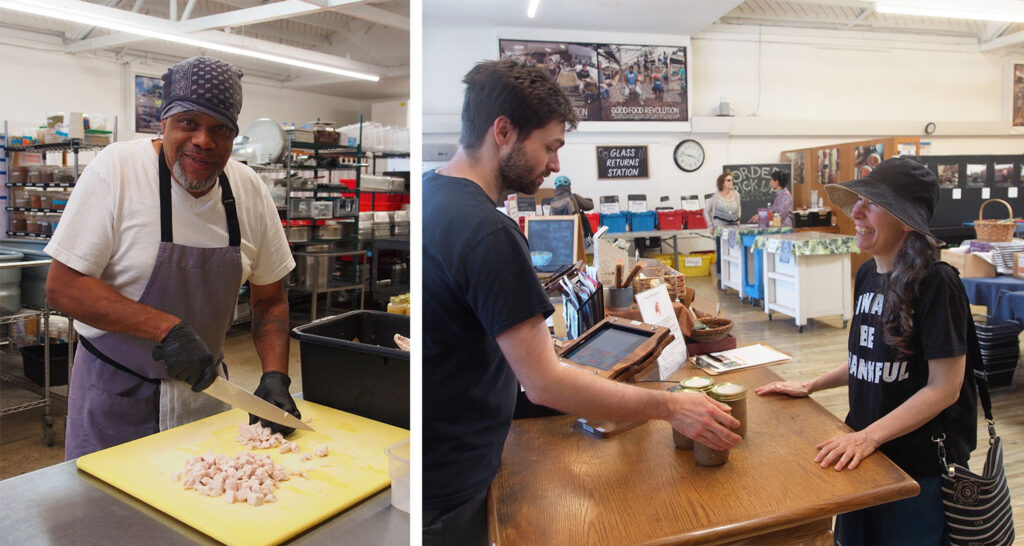
Left: Kwan chopping chicken Right: Noah Usher working check-out
Making it Work Without a Boss
Formed in 2006 by Larry Wisch, Jessica Prentice, Porsche Combash, Catherine Spanger, and Misa Koketsu, TSH is a member of the Network of Bay Area Worker Cooperatives. Non-owner employees (there are currently 30) became eligible to assume an ownership role in 2014, a process that requires learning about multiple aspects of the business. Mary Dee explains that the 10 worker-owners receive vacation pay, a higher discount on products, and patronage (a share of the profits) if the company makes money.
Dee started by cashiering, fulfilling orders, and helping with inventory before she took on development of recipes for their house-made products. Now she also runs the online store, manages inventory, and recently teamed up with Noah Usher (who became a worker-owner in 2024) to negotiate a new lease for their space. Usher co-leads the fermentation department, works as a cashier, and managed the transition to a new phone service provider.
“A lot of unique challenges get thrown at you as a worker-owner, and we collaborate and figure out how to solve them,” Usher says.
How are decisions made in the absence of a traditional hierarchy? For better or worse, says Mud Hut, they generally rely on a consensus model. “It depends on the scale of the decision,” he says. “Somebody or some smaller group usually takes the lead, does research, and puts an idea together. Sometimes the deciders may just be the three menu planners, or it might include a next layer of people, or all the worker-owners may be involved if it’s a big business decision.”
Usher adds that consensus can be strong, where everyone says yes, or weak, where several people abstain and a few people say yes. “We’re really good at coming to a consensus on emergent issues,” he adds. “We don’t tend to bicker and debate when we need a new compressor for our walk-in, even though it is $7,000. It’s a food-safety issue.” A harder decision, currently under discussion, is whether to adopt a big increase in the marketing budget.
TSH in a Changing World
As doctors increasingly encourage dietary changes to support health, once-hard-to-find foods have become more widely available. For example, says Mary Dee, “You can go to Trader Joe’s and buy organic coconut aminos, which was a unique product that we had on our shelves years ago as an alternative to soy sauce.” And while such examples are powerful validations of the vision of the TSH founders, they also create complications. “We were a big fish in a very small sea 20 years ago [among] people who were really committed to a certain dietary philosophy and framework,” says Mud Hut. “We were pretty much the only game in town. And now Trader Joe’s picks up on something and we can’t compete with their prices. Things [at TJ’s] are going into plastic, and ingredient compromises are being made for the sake of profitability. It’s a toss-up of benefits and compromises.”
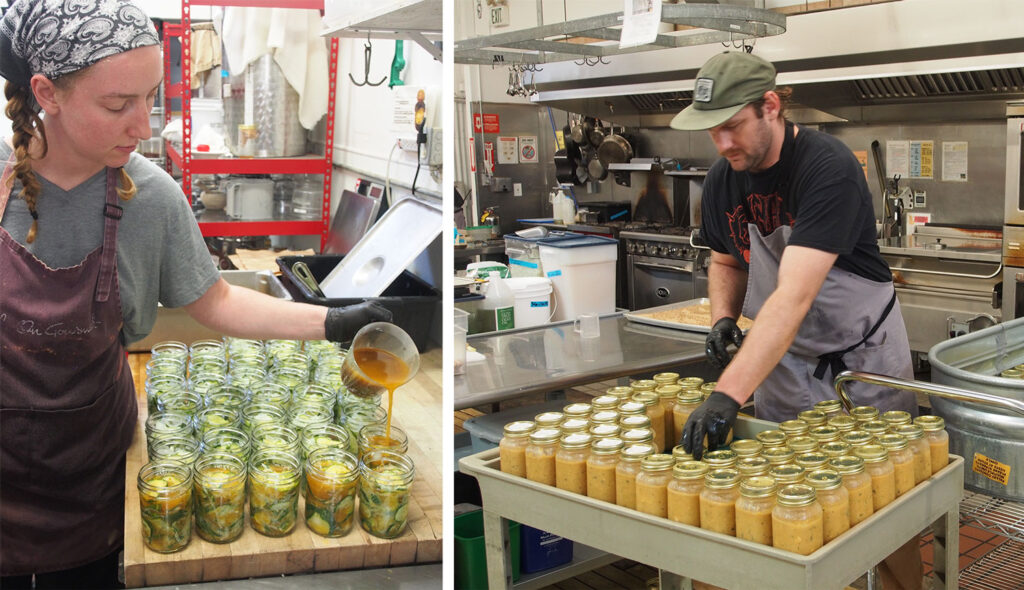
Left: Anke pouring brine for zesty zucchini pickles. Right: Jules moving jars from the cooling tank to a cart.
Customers Feel the Magic
Top of mind at TSH is finding ways to maintain standards and integrity while keeping their food affordable. They’ve done this, in part, by gradually adding more vegetarian and vegan dishes. They also regularly rework recipes, replacing prohibitively expensive ingredients with more affordable, but always tasty, choices.
Quality control (QC) sessions take place weekly, with workers tasting every dish and giving feedback. Dee describes the time when a QC tasting flagged the new Tuscan White Bean Dip, which had come out rather soupy. It had already been sold to several people, so each received an email explanation for why the dip was pulled and a credit for the purchase.
Customers can also count on detailed ingredient lists, essential for anyone who needs to avoid certain foods due to allergies, intolerance, or sensitivities. “We’re trying to meet people in that moment of a more serious intention around food,” says Mud Hut. Special requests to hold an order while a customer is out of town or to deliver food to an elderly parent in the neighborhood are generally met with, “We’ll work it out.”
Dee recalls a time when she was able to meet the moment for customers following the GAPS (Gut and Psychology Syndrome) diet simply by omitting one or another ingredient in certain recipes. “Those dishes started selling really well,” Dee says, “whether someone was on the diet or not.”
Like the individual dishes and the menu, the business will continue to evolve. “The questions and challenges that have arisen as we’ve grown have been a continual exercise in balancing our mission with the sustainability of the business,” says Mud Hut. “On one hand, no more volunteers, no more peeling garlic by hand; on the other hand, we’re still washing Mason jars and slow cooking our bone broth overnight. Changes, but no shortcuts.” ´
Writer Rachel Trachten jumped at the chance to delve into the history of Three Stone Hearth, as she has long enjoyed their prepared foods. Read her stories, including pieces about other local worker cooperatives, at clippings.me/users/rachel_trachten.