Three Sisters Vegan Chili
By Mut Hut and the Three Stone Hearth Kitchen | Illustrations by Kieren Dutcher
Like many dishes made at Three Stone Hearth, this recipe draws from Indigenous wisdom, both agricultural and culinary.
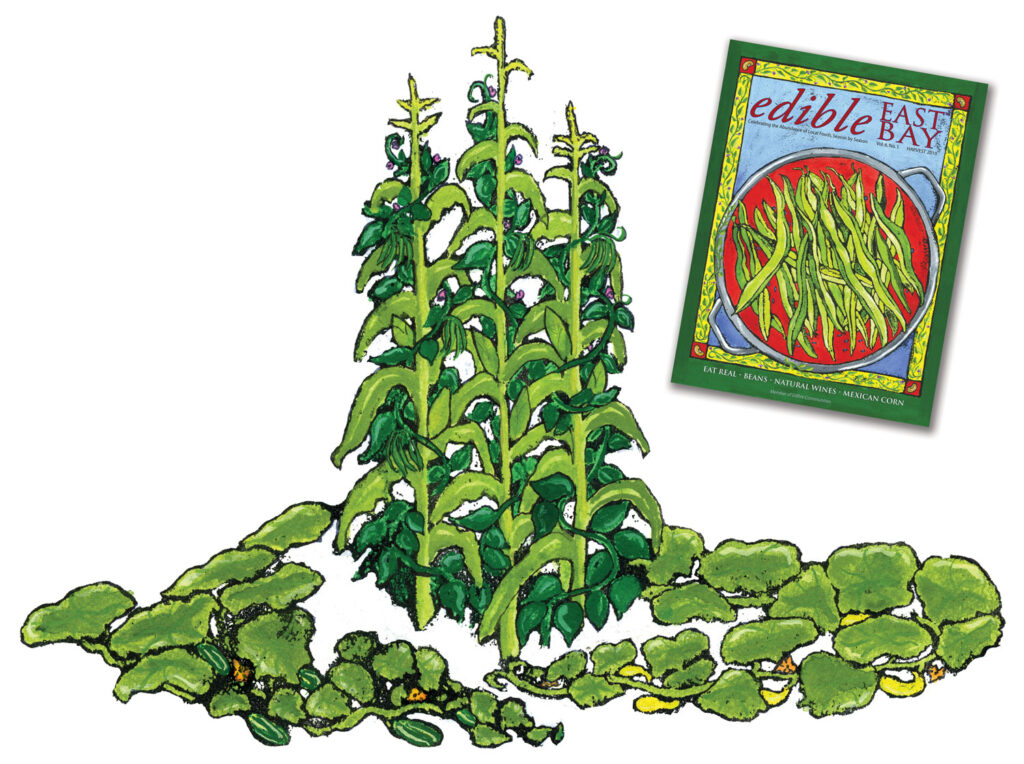
The three sisters concept starts in the ground. Corn stalks grow tall, providing a trellis for the beans to climb and weave across. Large-leaved squash plants run along the ground, providing shade, conserving water, and creating a living mulch that feeds the soil and helps prevent pests. The beans wind through it all as their roots fix nitrogen from the air into the soil, feeding the fast-growing roots of their hungry sisters.
This represents a worldview of cooperation over competition, of living in balance with an environment that nurtured Indigenous societies throughout the Americas.
In the kitchen, each sister requires its own preparation to support digestibility and maximize nutrient availability. We soak dry beans overnight with a bit of sea vegetable added to enhance the nutritional profile. The posole (corn hominy) is nixtamalized: steeped in alkaline water to begin the sprouting process, activate enzymes that support digestion, and especially, to make the all-important B vitamins bioavailable. Wood ash was often used as an alkalizing agent, but today a culinary version of mineral lime is the standard.
The beans and corn combine to provide a complete protein, along with fiber and many other macro- and micronutrients. The squash and tomato provide vitamins and antioxidants, while the squash contains a balance of soluble and insoluble fiber that supports the gut microbiome while also being excellent for hydration. Colorful spices and garlic are always a good source of antioxidants and other health-supporting compounds. Reasonably fresh organic spices are ideal. The stew is finished with cilantro, which is especially high in vitamins A, C, and K, potassium and iron, and other flavonoids and carotenoids.
This recipe is adapted from one we use in our kitchen at Three Stone Hearth. As TSH co-founder Jessica Prentice always reminded us, “Our recipes are very forgiving!” This is folksy, rustic cooking, not haute cuisine. Depending on your level of comfort and inspiration in the kitchen, feel free to adapt and improvise. As we remind our cooks here all the time, take good notes so you can make the dish more to your liking with each iteration. Just don’t add any salt to the beans until after they are cooked.
Getting Started
This recipe takes you through the full process followed in our commercial kitchen, but if you are not up for a two-day project and just want to make a pot of chili for tonight’s dinner, read through the Day 1 descriptions to find your shortcuts.
General notes
Ideally, use filtered water (but not distilled) for steeping the hominy and soaking the beans before cooking.
If you’re not concerned about keeping the recipe vegan, feel free to cook the hominy and the beans in bone broth for extra flavor and nutrient-density. The broth should be unsalted, as salting bean-cooking water can cause beans to seize and become difficult to cook thoroughly.
We use coarse Celtic sea salt, but any quality naturally mined or sea salt (like Himalayan) is fine.
Day 1—Soak and cook The Hominy
We recommend you start with dry hominy (posole), but if you want to skip the work of steeping and cooking it, you can use a 12-ounce can. We get our organic, heirloom uncooked posole locally from Alma Semillera, a small Richmond-based company dedicated to supporting regenerative agriculture, fair trade, and native foodways. You can get the culinary lime, known as cal, in most Latino markets.
In a medium pot, bring 2 cups filtered water to a boil. Turn off the heat and stir in ½ tablespoon cal. Add ¼ pound dry hominy, making sure it’s covered by at least 4 inches of hot filtered water. Cover the pan and let hominy steep sit overnight.
The next day, drain and rinse the hominy, place in a baking dish, and cover with at least 4 inches water (or broth). If the dish has a cover, use that or improvise with a sheet of parchment paper covered with a sheet of aluminum foil that’s crimped down to create a seal.
Preheat oven to 425°F (400°F if you have a convection oven), and bake for 2 ½–3 hours, checking and stirring every hour or so. Hominy should be fully tender but not mushy. When it’s done, drain the hominy and save the cooking liquid for possible use later.
Day 1—Soak and cook The Beans
We use butter beans from Iacopi Farms in Half Moon Bay. You can also use gigante, Lima, or other large white beans.
Again, if you want to skip the soaking and cooking, one 15-ounce can of cooked beans would equal the amount you’d get from soaking and cooking ¼ pound dry beans. Eden brand canned beans are organic and cooked with a sea vegetable in the same way we do it in our kitchen.
To use dry beans, heat 2 cups filtered water almost to a boil. Add ¼ pound dry butter beans and a small piece of kombu or other dried sea vegetable. Add a tiny pinch of baking soda to alkalinize the soaking water. Add more hot filtered water to cover the beans by at least 4 inches. Cover with a lid and leave out overnight.
The next day, preheat oven to 425°F (or 400°F if you have a convection oven). Note that this is the same temperature for cooking the hominy, so you can cook both at the same time.
Drain and rinse the beans, place them in a baking dish with the sea vegetable, and add water or unsalted broth to cover the beans with at least 1 inch of liquid. Cook for 1–2 hours. During the second hour, check beans every 15 minutes. They should be soft but not mushy. Remove from oven when done.
Drain cooked beans and reserve cooking liquid.
Three Sisters Vegan Chili
This is what you do on Day 2 unless you are using canned hominy and canned beans so you can cook and serve on the same day.
Chefs’ Note: Any time you are cooking, it’s a good idea to record your adjustments. At Three Stone Hearth, after making all the dishes for the week, we hold an in-house tasting panel to gather feedback from the staff; our recipe editor then integrates any significant feedback from the panel and notes from the cooks for the next time we make the dish.
Serves 4
- 2 ounces extra virgin olive oil
- ½ pound sliced yellow onions
- 1 tablespoon Celtic sea salt
- ½ teaspoon coriander seeds
- ½ teaspoon cumin seeds
- Tiny pinch of cinnamon
- Tiny pinch of chipotle powder
- ½ teaspoon sweet paprika
- ½ teaspoon sweet smoked paprika
- 1 ounce fresh garlic, finely minced
- 1 (15-ounce) can crushed tomatoes
- Cooked hominy (see Day 1)
- Bay leaf (use 1/4 to 1/2 depending on size)
- Hot liquid, as needed (bean or hominy cooking liquid or hot filtered water)
- ½ pound squash (use any squash that’s in season)
- Cooked butter beans (see Day 1)
- 1 tablespoon apple cider vinegar
- 1 ounce cilantro, finely chopped (use more if you like it a lot)
To make the chili: Heat olive oil in a large pan or skillet over medium heat. Add sliced onion and a little salt and sauté until soft. Add coriander, cumin, cinnamon, chipotle, and both paprikas and continue cooking until onion is completely tender and spices are well cooked. Add garlic and stir.
Add crushed tomatoes and cooked hominy. Crush bay leaf with a bit of salt and add to the mixture. Bring to a simmer and cook until the hominy is soft but not falling apart. Add plenty of bean cooking liquid or filtered water as needed to keep the stew from being too thick.
Add squash and stir. Simmer, stirring occasionally, adding bean cooking liquid or filtered water as needed to keep the stew wet and saucy.
When the squash is just tender, add the butter beans and as much of their cooking liquid as necessary to keep a good consistency. Bring back to a simmer.
Add apple cider vinegar. Stir, taste, and adjust seasonings as needed.
To serve: You can serve the stew as is, but we like to garnish with cilantro and might add diced avocado, hot sauce, a dollop of sour cream, or all of the above.
Enjoy the fruit of your handiwork and take a moment to offer gratitude to the earth and the ancestors in any way that feels right for you.
Mud Hut started at Three Stone Hearth as a volunteer from 2007 to 2011, becoming a staff member in 2011, and a worker-owner in 2014.